

Sophie is two. She lives in Oklahoma City, three hours up the interstate from my house in Fort Worth, so most of what I know about her toys comes to me by video call, held up to the camera by my son Daniel while she hollers in the background for him to hand it over. The toy that shows up most often on those calls is the Melissa & Doug Rainbow Stacker, seven wooden rings on an upright rod, and it is the reason I sat down to write any of this.
I learned what makes a stacking toy safe the hard way. Not from the box, and not from one of those articles with a numbered checklist. From watching Daniel pick nine pieces up off a tile floor for the fourth time in one evening while Sophie yelled at him to do it again. The toy aisle does not make any of this easy for a grandmother shopping from three hours away. Half the stackers on the shelf are plastic with a battery door, and a battery door means a screw or a latch that a two year old will worry at for twenty minutes and then hand to you with a look of triumph. Some have a rattle bead sealed up inside. Some have a ring that looks glued on until the day it is not. You cannot squeeze any of that through a phone screen, so I did what I usually do. I bought the one that has not changed shape since I was buying toys for my own children, and I mailed it to Oklahoma. Seven wooden rings, a topper piece, and one solid wood base. It has been in Daniel's house about six months now.
Nine pieces, no batteries, and nothing to lose in the carpet
The Melissa & Doug Rainbow Stacker is seven wooden rings, a topper and a solid wood rocking base. Recommended for 18 months to 3 years. It is the one toy I have mailed to a grandchild and never once worried about.
Amazon Check Today's Price on Amazon →Here is how I would sort through the shelf if I were standing next to you in the store, which is where I would rather be. Five things I check now, in this order, and not one of them requires you to be a child development expert. If you only read one of them, read the first one, because the rest of the list does not matter if the toy is the wrong age for the child in front of you.
Step 1: Match the age on the box to the child, not to the birthday on the calendar
The Rainbow Stacker is labeled 18 months to 3 years, and that range is honest. Under 18 months, a baby is still putting everything in her mouth first and asking questions later, and a hard wooden ring is a rough thing to gnaw on. Over 3, a child wants to build something that stays built. Eli is 4, and he will stack three rings, knock them down, and be back at his magnetic tiles inside two minutes, because a stacker only stacks one way and he has already solved it. He is not being difficult. He has simply outgrown the question the toy is asking.
Sophie at 2 is dead center. She gets three rings on before the thing wobbles, she hands me the topper so I can set it on the rod for her, and then she claps for herself like she has landed a plane. That is the whole toy. If your grandchild is 15 or 16 months, wait a season and put it on the closet shelf. This is a toy for a window, and the window runs about eighteen months wide. That is why the age on the box is worth more than the picture on the box, and why I would rather wait four months than buy a child something she cannot use yet.
A word about buying ahead, because I have done this to myself. Every December I get the urge to buy two sizes up so the gift lasts. That works with pajamas. It does not work with a toy where the whole point is that the child can do it herself. A stacking toy in the closet is not a gift yet. It is clutter with a bow on it, and by the time the child is ready for it, you will have forgotten where you put it.
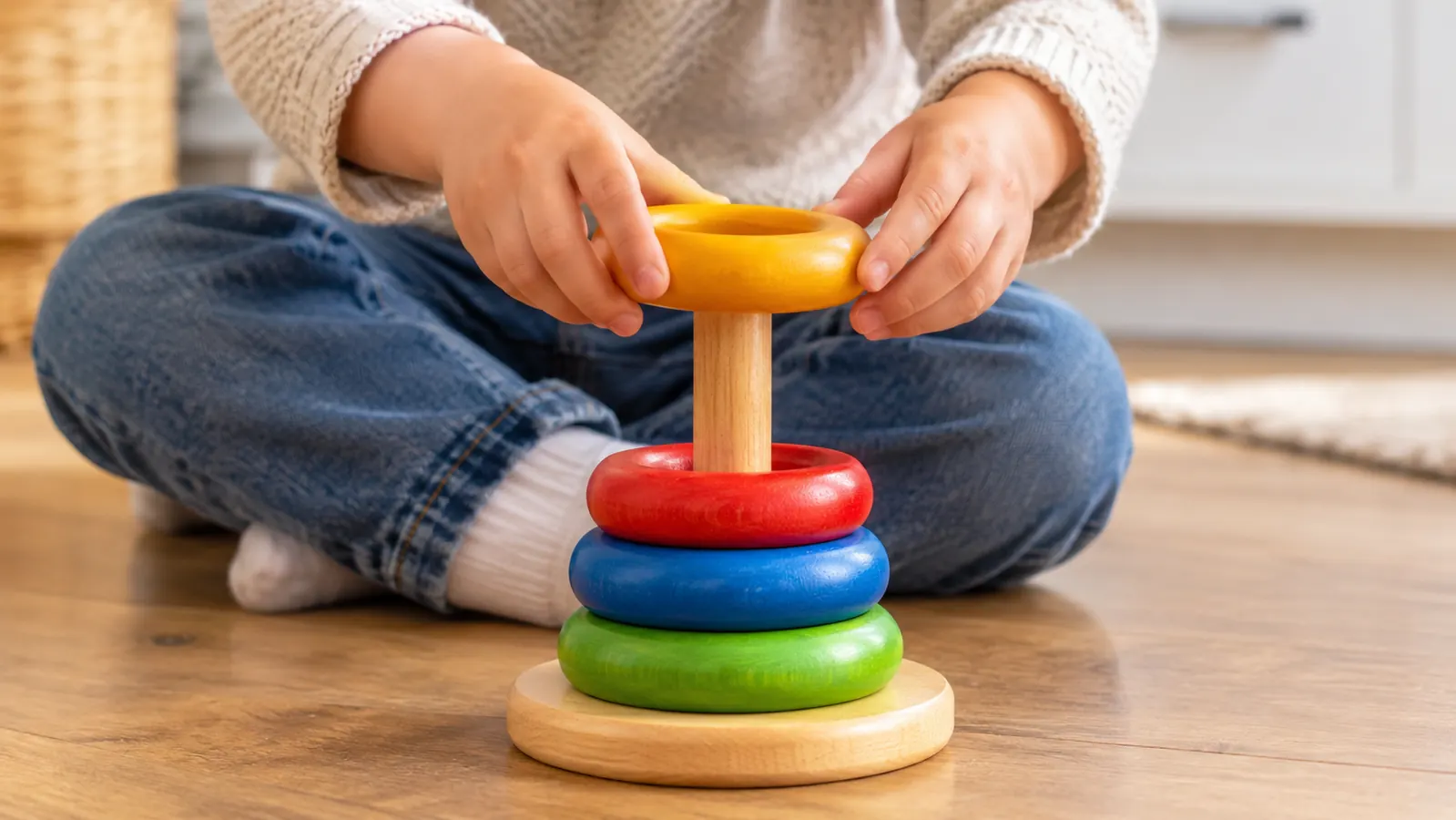
Step 2: Count the pieces and find the smallest one
Nine pieces. Seven rings, one topper, one base with the rod coming up out of it. The smallest piece is the topper, and it is not small enough to swallow, but I still got down on the floor with it the first time I visited after the box arrived and looked at it from a two year old's height. That is the test. Not the warning label on the box, which I read too, but the actual piece in your actual hand.
This toy has no batteries. No battery door, no screw, nothing to open. Wood and a rod is the whole electrical system of it. I want to be plain about why that matters to me at 66. A toy without a battery compartment cannot be left running, cannot be left standing open, cannot be dropped in the bathtub and filled with water, and cannot teach a child that the fun part is the part she is not allowed to touch.
Then count what could go missing. The rings on this one are big enough to turn up. I have found one under the couch and one in the bottom of a cloth grocery bag, and I have never once found one in the vacuum canister, which is more than I can say for the small plastic pieces that came with other gifts over the years. At six months in, all nine pieces are still in Daniel's house. Nine is a number you can keep track of. Forty is not.
Step 3: Pick it up before you decide anything else
Weight tells you more than the box does. The Rainbow Stacker is 0.36 kilograms, a bit under a pound, which means Sophie can carry the whole thing by the base with one hand while she walks, and she does, from the living room to the kitchen and back again. A toy a two year old can move by herself is a toy she will actually play with. A toy she has to ask an adult to lift is a toy that lives on the shelf.
Then run your hand over it. The pieces are smooth and easy to grasp and sized for a small hand, and the base is solid wood with a rocker to it, so the stack tips and wobbles instead of standing rigid. That wobble is half the fun. It is also the reason Sophie has to slow down and place the ring instead of jamming it down the rod. If you are ordering online, the equivalent of running your hand over it is reading the material line and looking for solid wood instead of something coated.
One more thing, and it works in the store or at your own kitchen table. Turn the toy upside down and shake it. Anything that rattles loose in there is a piece that is going to come off in a house with a toddler, usually on a day when nobody is looking.
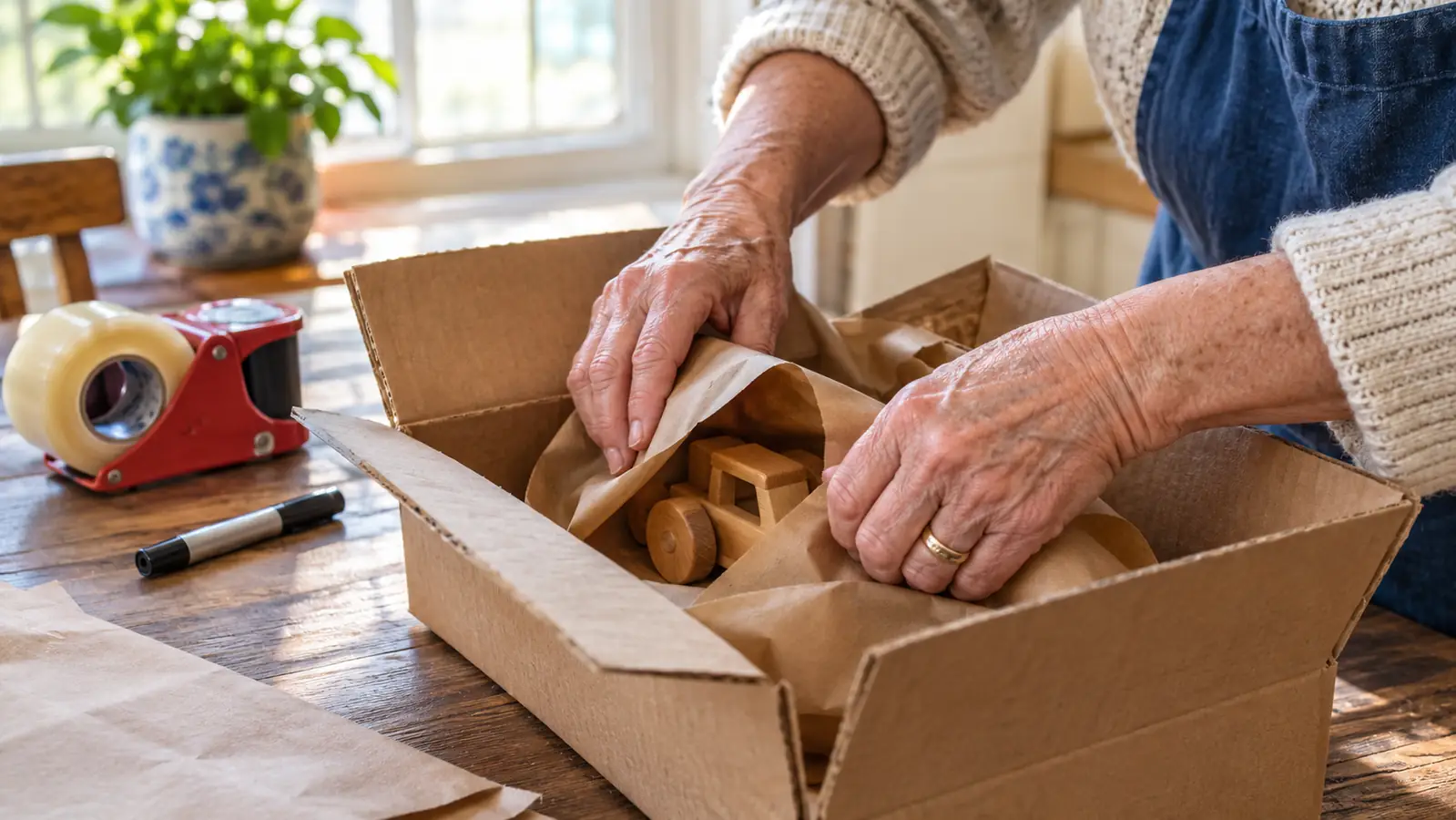
Step 4: Decide where it will live before you buy it
I mailed this one, and nobody writes about that part. It went into a cardboard box with brown paper, with three hours of interstate between me and it, and it arrived without a mark on it. Wood survives a mail truck. A plastic toy with a snap-on lid does not always survive a mail truck. If you are a grandparent who shops from a distance, the toy has to survive the trip before it ever gets played with.
Then think about the room it is going into. At Daniel's house this one lives on the low shelf in the living room, and it ends up on the kitchen floor while he makes dinner, which is exactly where a toy ought to be. At my house the toys live on the bottom shelf of the grandkids' room, where Mia and Eli can reach them without asking permission. If a toy needs an adult to get it down, it gets played with twice and then it is furniture.
And think about who else is in the house. If there is a baby crawling around, the rings will end up in that baby's hands, and they are big enough that this is fine. If there is a four year old, he will build a tower so the two year old can knock it down, and that is the best thing that can happen to a toy. The worst thing that can happen is that it lives in a bin with a lid on it, because the lid is the part the adults can work and the children cannot.
Nine pieces, six months, a tile floor, and every single piece is still in that house. That is the whole review.
Step 5: Buy for the years, not for the season
The plastic stacker with the light-up button is not a bad toy. It is a toy that is finished the day the batteries die and nobody in the house can find a screwdriver. I have watched that happen more than once, and I have watched a child hand it to her mother with the flat acceptance of somebody who already knows. The wooden one has no such ending. It makes no sound and it lights up nothing, and it is as interesting in month eight as it was in week one, because the interesting part was never the toy. It was Sophie working out which ring sits flat and which one wobbles.
Six months in, the Melissa & Doug stacker looks used. There is a dent in the base from the tile floor and a tooth mark on the topper. All nine pieces are still in the house. After six months with a two year old, that is the only durability test I trust, and it is not one you can run in a store. It is also the kind of toy that gets packed in a box again when a cousin turns two, which is more than I can say for most of what I have bought in the last five years.
I am not going to tell you every wooden toy is better than every plastic toy. I am telling you that this one is still whole, and the ones with buttons are in a bin in the garage.
What Else Helps
A few things that made this toy better at our house, and none of them cost a thing.
Sing while you stack. I sang in the church choir for thirty years and I still cannot pass up a chance, so we do The Itsy Bitsy Spider and Sophie puts a ring on for every line, and when the song is over she knocks the whole thing down and we start again. You can name what she is holding while she is holding it, which is most of what this toy is for at two. The box calls it color recognition. At my house it is called Glenda, tell me about the one in your hand.
Give the toy a home. A cloth bag or a basket on a low shelf, so that cleanup is one motion and not a treasure hunt at eight in the evening. And resist the urge to buy the second set. One of these is plenty. Two sets means the rings get mixed together and nobody can ever find the topper.
Keep the rod side up when you set it away. It sounds silly, but a two year old stepping on the bare rod on a tile floor is the only genuine complaint I have about a toy like this, and it takes one second to turn it over. If you have a hard floor, a folded towel under the base during play quiets the clatter and keeps the wood from picking up dents.
Last thing, and it is the thing I tell everybody who asks me what to buy a two year old. Buy the toy that does one plain thing well, and then get down on the floor and do it with them. The stacking toy is not the entertainment. You are. The toy is just what the two of you have in your hands while it happens, and that is why I have never once regretted putting this one in a box and mailing it three hours north. Sophie will outgrow it before her next birthday. I will remember the video calls long after that.
The toy I would mail to a two year old tomorrow
Seven wooden rings, a topper and a solid wood rocking base. No batteries, nothing to open, recommended for 18 months to 3 years. Six months of use in a house with a toddler and every piece is still there.
Amazon See It on Amazon →