
I learned the hard way that a living room full of grandchildren with nothing to do in it turns into a wrestling match inside twenty minutes. Mia was five the first time she asked to put on a show, so I handed her a hairbrush, stood her on the hearth, and she sang something that was either Twinkle Twinkle or a song she made up about a cat. Eli was two and tried to eat the hairbrush. Sweet afternoon. Also a lot of work for one hairbrush.
What I wanted was a way to hand them the whole show at once. Music, microphones, the feeling that the living room had turned into somewhere else for an hour. The YLL Mini Karaoke Machine with four wireless microphones does that at my house, and it has done it most Saturdays for about ten months, ever since the week before Christmas when I bought it mainly for Mia. It lives on the toy shelf in the grandkids' room. It does not go home with anybody.
A note on what this is not. It is not a toy that sings at you, and it is not a subscription. It is a small speaker with four microphones that plays whatever is on my phone. That is the whole of it, and that is exactly why it works.
Four microphones are the reason this one works and the hairbrush did not
Bluetooth from a phone or tablet, no app, no subscription. Our YLL has run most Saturdays since Christmas and has not lost a microphone yet.
Amazon Check Today's Price on Amazon →Step 1: Pick the room and clear a stage
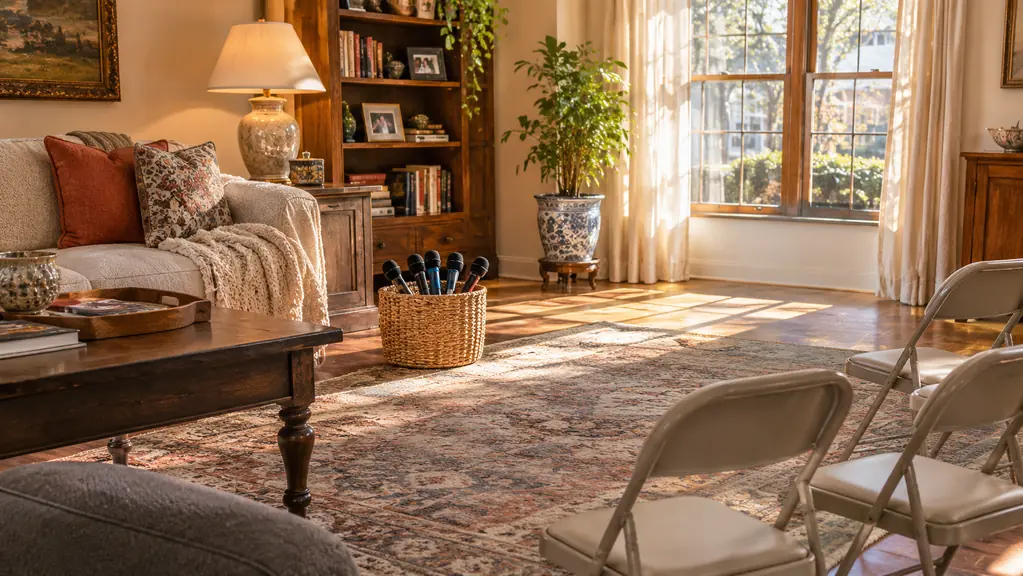
Not the grandkids' room. That one is for sleeping and for the toy shelf. The show happens in the living room, where there is a rug, a hearth to stand on, and enough floor for an audience in folding chairs. The hearth matters more than it sounds like it should. It is about six inches off the floor, which is the exact height that makes a child feel like the room is looking up at them, and it is flat enough that nobody tips over mid-verse.
The YLL machine is small, 3.94 by 1.97 by 3.15 inches and 340 grams, so it sits on the end of the coffee table without taking the whole surface. The mics go in a basket beside it. I set it down, turn it on, and that corner of the room becomes the stage. It can also stand on the floor when the coffee table is spoken for, which it often is, because Eli builds on it. Floor standing or tabletop, either one works, and I have used both in the same afternoon.
Then I move what I do not want knocked over. The good lamp goes to the hall. The bowl of pinecones goes on top of the bookcase. The stack of library books goes in the hall closet, because Mia reads them and Eli lands on them. Fifteen minutes of clearing buys me two hours of not saying careful every ninety seconds, and I have found that the fewer times I say careful, the longer the afternoon lasts.
The first Saturday I tried this, I did not clear anything, and the lamp by the couch went over during the second song. Nobody was hurt and nothing broke, but I spent the rest of the afternoon watching the lamp instead of watching the children, and that is a poor trade. Now the lamp leaves the room before the children arrive.
One more thing about the room: the light. Saturday afternoon sun through the front window is the best stage lighting there is, and it costs nothing. I open the curtains, turn off the television, and get out of the way.
Step 2: Load the music before they walk in
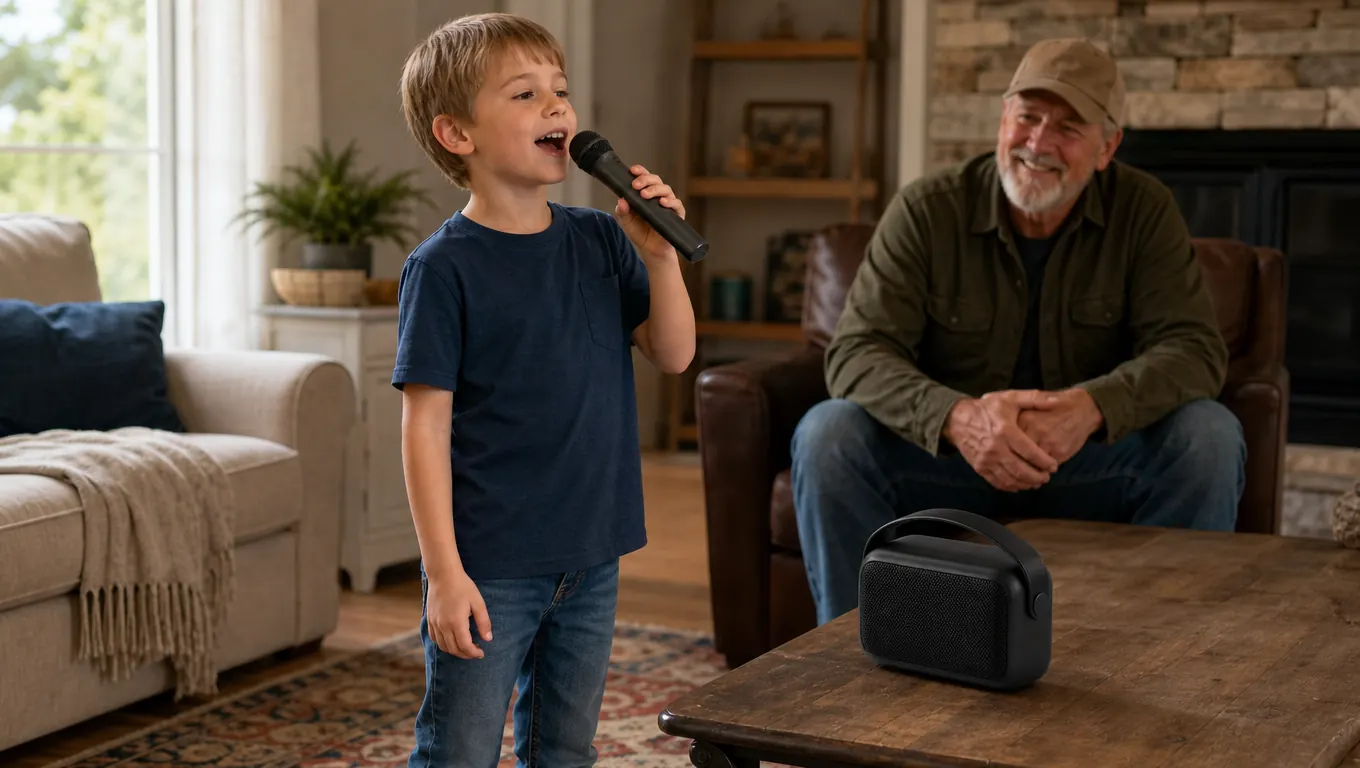
Songs come off my phone over Bluetooth. No app, no account, no monthly anything. That was the whole reason I chose this over the kind of toy that wants a subscription before it will play a note. The YLL pairs with a phone, a tablet or a laptop the same way, and it took me one try and about a minute to get connected the first time. The only moment it ever gave me trouble was a Tuesday when my phone was mid-update, and turning the phone off and back on fixed it.
I do the pairing while the coffee is still brewing, before Rachel drops the kids off. Pairing in front of two impatient children, one of whom is four, is a bad use of anybody's afternoon.
The playlist is half theirs and half mine. Mia's half is whatever she is singing at school plus a few things off the movies. Mine is Elvis, and I am not apologizing for it. Eli does not care what plays as long as it is loud and there is a drum in it.
The feature I did not expect to lean on is the button that pulls the vocals back on a Bluetooth track. With the singing reduced, a seven year old who only knows the chorus can still finish the song, and a four year old can shout the parts he knows without the record singing over him. There is also a slot for a TF card if you want to load your own music. The card is not included and I never bothered, because my phone has been enough. I tried once to make a card of Elvis songs for a road trip and gave up at the kitchen table with the instructions in my lap. The phone was already working.
I queue about ten songs and stop there. Ten is plenty. Nobody has ever asked for an eleventh, and ten is roughly where my patience and the afternoon both run out at the same time.
Step 3: Set three rules before the first song
Four microphones is the number that matters, and I did not understand that until the first Saturday. With four, Mia, Eli, me and whoever else is in the room can all hold one at the same time. Nobody waits. Nobody has to be told to wait, and at my house being told to wait is where most of the trouble starts. Four channels on the machine, four mics in the basket, and that is the arithmetic that keeps a Saturday peaceful.
The rules fit on one hand. One song each, then hand the mic to the next person when the song ends, not when you feel like it. Hold the mic a hand's width from your mouth, not against your teeth. And nobody sings while somebody else is singing, unless it is the chorus, because a chorus belongs to everybody.
The volume is 5 watts and that is plenty for one living room. I set it once and leave it alone. Eli, who treats a microphone like a megaphone, worked out faster than I expected that the sound gets bigger when he backs off and sings instead of yelling. He still yells sometimes. He is four.
The rule about the teeth came out of a real afternoon. Mia sang an entire song with the microphone pressed to her front teeth and it came out muffled and buzzy, and she thought the machine was broken. It was not. She had the microphone in her mouth. Now she holds it out and the difference was obvious to her the same day, which is better than any explaining I could have done.
The other rule is mine, not theirs: I do not correct anybody's singing. Not the tune, not the words, not the hand gestures. I spent my working life in a school office, and I know how quickly a good time turns into a lesson. There will be time for lessons. Saturday is for the show.
Four microphones turned out to be the whole thing. With four, nobody waits, and nobody has to be told to wait, which at my house is the same as a peaceful afternoon.
Step 4: Hand over the production
The part I got wrong the first few times is that I kept running the show. I picked the songs, I announced the acts, I told everybody where to stand. It was fine, and it was also not a show. It was me directing children in my own living room, which is a job I have already retired from.
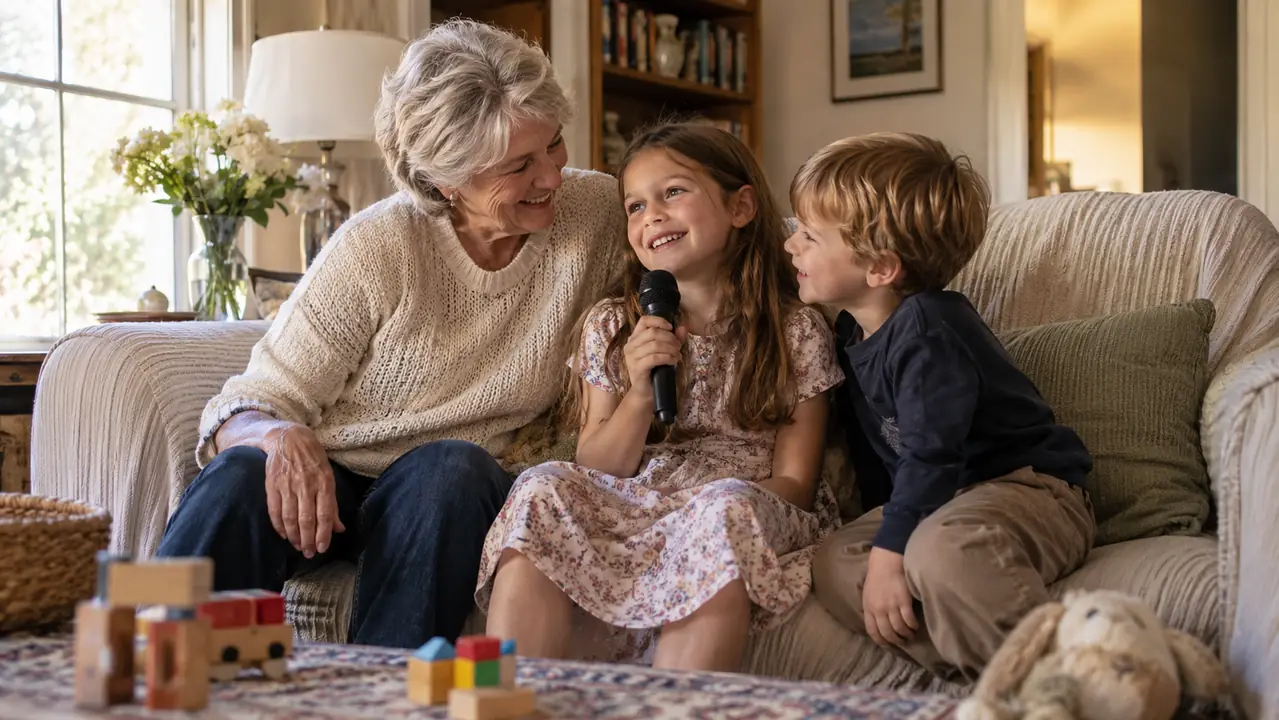
What works better is handing over the parts that do not matter. Mia makes tickets out of index cards and charges me a button to get in. She writes a program in her best handwriting. She decides who sings when. I keep the phone and the volume, and that is the whole of my job. The tickets are the part she loves most, and I have a drawer in the kitchen with about forty of them in it, all dated, because she dates them.
The costumes come out of the dress-up trunk in the grandkids' room closet. Mia is seven and small for her age, and the skirts still fit, though they are shorter than they were two years ago, so there is a leggings rule. Eli wears the tiara and takes it very seriously. Sophie, who is two and lives in Oklahoma City, mostly watches from my lap when she visits, and that counts as a performance too.
The first time I tried handing over the program, Mia wrote it out and then announced that the show would be three hours long, because she had given everybody four songs. I let her get to about the fifth song before I said we were at the halfway point and there would be a snack. It is a negotiation, not a handoff, and I have gotten better at it.
Between acts there is a break, and the break is where the card tin comes out. Go Fish at the kitchen table, then back to the rug for the second half. The break is not optional. The break is what makes the second half possible.
Step 5: End it while everybody still likes each other
Every good afternoon has a cliff at the end of it, and the trick is to stop before you go over. I announce the last song ten minutes before the last song. Mia chooses it. Then the machine goes off, the mics go back in the basket, and we have a snack.
I plug the YLL in on the kitchen counter after they leave, and everything goes back on the shelf. That is two minutes of work, and it means the next Saturday starts with the machine ready instead of a hunt through the house for a missing microphone. In ten months we have not lost one, and I credit the basket. The charging cable stays plugged in behind the coffee canister so I can find it, because the one time I put it in a drawer I could not find it for a week.
The other end-of-day matter is durability. The machine is plastic and light, and a four year old who has decided a microphone is a drumstick will test it. The YLL has come through ten months of that, and it carries a two year warranty, which is the kind of thing I check now. I have bought one too many toys that quit in a week and left me explaining it to a crying child. The mics have taken the worst of it, dropped on the rug and once on the porch, and they still work.
And if something does go wrong, the fix is usually the boring one. Plug it in. Re-pair the phone. Turn it off and turn it back on. I am not handy and I have not needed to be.
What Else Helps
A snack that does not need a fork, because forks and microphones do not mix. I do popcorn in a big bowl and a pitcher of water on the counter, and everybody serves themselves between acts. Paper cups. Nothing glass anywhere near the rug.
The tin of card games earns its place too, and not only on karaoke day. Six decks in one tin, small enough for my purse, and it has covered restaurant waits, a doctor's office and the three hour drive to Oklahoma City. Mia's game is Old Maid. Eli's is Slap Jack, and he wins more than he should, which I have decided not to investigate.
One more thing, and this one matters to me. If your grandchildren live far away, as Sophie does, the YLL works over a video call. She holds a mic on her end and I hold one on mine and we sing the same song badly across three hours of Texas and Oklahoma. It is not the same as having her on the rug. It is still something.
Start with the five steps and let the rest settle in on its own. The tickets, the programs, the leggings rule, the ten minute warning. None of it is complicated. It just needs somebody willing to sit down, hold a microphone, and be the audience for an hour.
This is the one that is still on the shelf ten months later
Four wireless microphones, Bluetooth from a phone or tablet, four channels so everybody sings at once. No app and no subscription, which was the whole point.
Amazon Check Today's Price on Amazon →