

Eli is four years old and he has never once played with a toy quietly. He is a knocker-downer. Give him a tower and he will level it with his forearm and laugh like he has won something. Give him a box and he will sit in it for about ninety seconds before he turns it into a ramp. So last spring, when I went looking for something for him, I was not really shopping for a toy. I was shopping for a toy that could survive him.
What I landed on was the PicassoTiles 100 piece magnetic tile set, and I bought it mainly for Eli. That was about eight months ago. Since then it has become the strangest thing on the shelf in the grandkids' room, because all three of them play with it and none of them play with it the same way. Mia is seven and she builds stages for her shows. Eli builds and then destroys. Sophie is two and mostly sorts pieces into piles and hands them to whoever is closest. The PicassoTiles box is the only thing in that room I have never once had to talk up. Nobody needs convincing. It comes out on its own.
The Quick Verdict
One hundred flat plastic tiles that stick together by magnet. No batteries, no app, no screen, nothing to charge. Eight months in, it is the toy my four-year-old grandson cannot break and my seven-year-old granddaughter keeps finding new uses for. The two-year-old needs an adult within arm's reach the entire time.
Amazon Check Today's Price →The one toy on my shelf that never needed selling
One hundred pieces, ages three and up, nothing to charge and nothing to download. It lives in a box on the bottom shelf and it comes out every single Saturday.
Amazon Check Today's Price on Amazon →How I've Used It
The pieces live in their storage box on the bottom shelf of the grandkids' room. That was the best decision I made about them. Low enough that Eli can haul the box out himself without asking, which matters more than it sounds, because a toy a child has to request is a toy that gets played with half as often. The box itself measures 14 by 11.63 by 3.13 inches and the whole thing weighs 5.5 pounds. That is light enough for a four-year-old to drag across a floor and heavy enough that I do not want to hand it down from a high shelf anyway. Bottom shelf was the answer.
They get built on the living-room rug in front of the television, and they get built on the kitchen floor while I am putting lunch together. The kitchen floor is honestly the better spot. It is flat and hard and the buildings stand up straighter there, and I can step over the construction while I am moving between the stove and the sink. The rug is softer and warmer and the walls lean. Eli does not care either way. Mia does. She has opinions about which surface holds a stage.
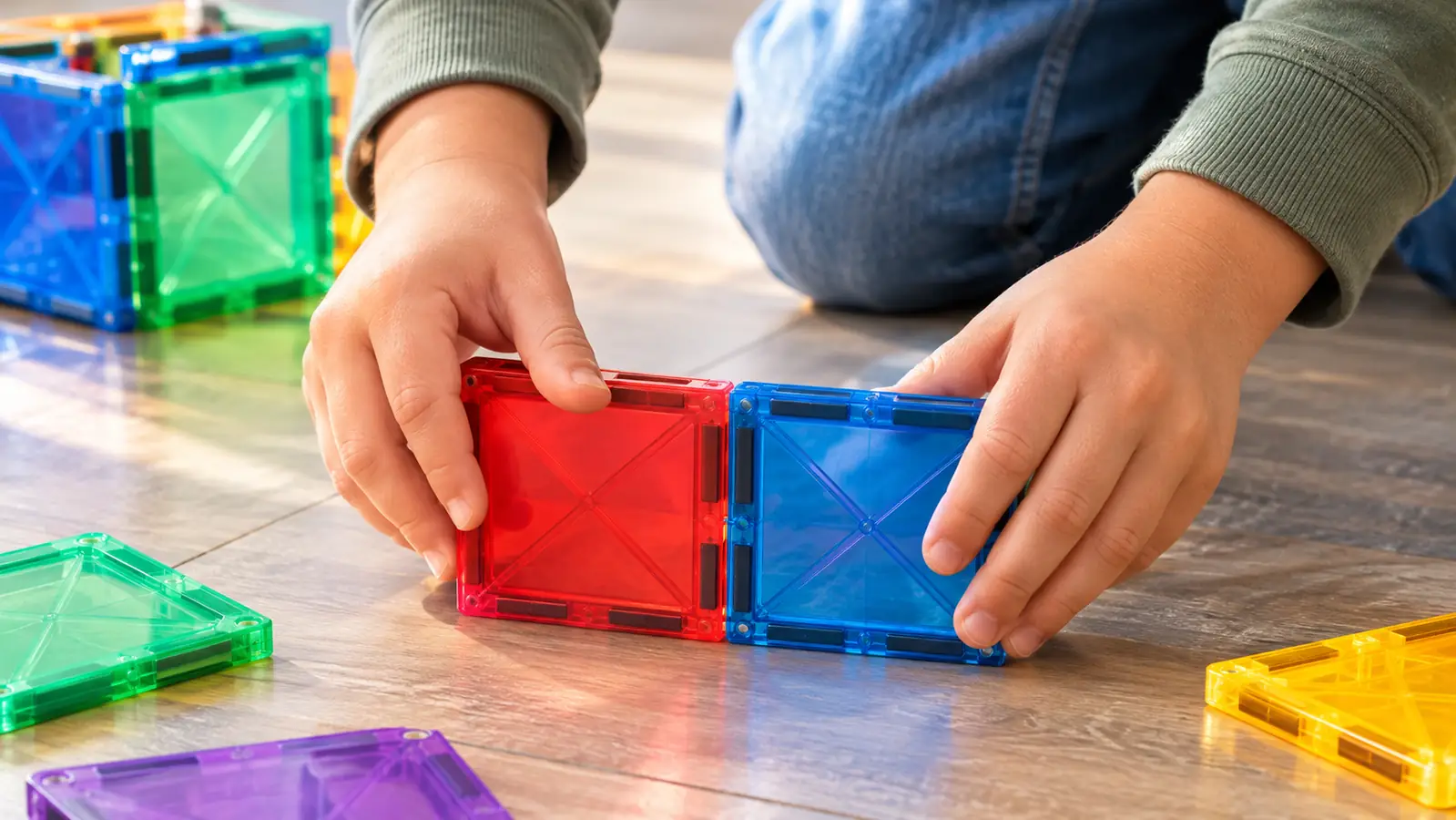
There is an instruction manual in the box. I did not need it and neither did Mia. You bring two edges near each other and they pull themselves together. That is the entire learning curve. The listing calls it manual operation, which is a flat little phrase for something that works exactly when a child picks it up and does absolutely nothing when nobody is touching it.
The first Saturday they were here with the box, it rained all afternoon and we never once left the living room. I had set the box down on the coffee table thinking I would dole the pieces out a few at a time, the way you do with something new, and that lasted about four minutes. Eli upended the whole thing on the rug and I had a moment of real panic, and then the two of them started building and it turned out that a hundred pieces spread across a floor is the entire point, not a mess to be managed. What I learned that afternoon was to put the box on the bottom shelf and let them take it down themselves, and to keep one firm rule: the pieces go back in the box before the box goes back on the shelf. Eight months on, that rule mostly holds.
What One Hundred Pieces Actually Buys You
A hundred sounds like a great many until you have children spread out around a rug, and then it sounds about right. It is enough that Eli can build something and Mia can build something else beside it without a negotiation breaking out. It is enough that when a whole structure comes down, which it does, over and over, there are still pieces left to start the next one. I have one set of one hundred. I have never felt the need to buy a second and I have never heard either of the older two ask for more.
There is nothing to charge and nothing to pair and nothing that beeps for attention at eleven at night. After two Christmases of toys that were dead by New Year because somebody lost a cord or the batteries ran down, that single fact is worth more to me than any feature on the box. The PicassoTiles set has no off switch because it has no on switch. It waits.
What you actually get is a box of flat plastic pieces in more than one shape, an instruction manual, and nothing else. No screwdriver, no batteries, no little bag of parts to lose behind the sofa. I have a kitchen drawer full of orphaned chargers from toys past, and not one of them belongs to this set. When Eli has finished with it, it goes back in the box and the box goes back on the shelf, and that is the whole of the cleanup. Sorting the pieces back into the box takes me about four minutes on my own, or considerably longer if Eli is helping, because his idea of helping is to take them all back out.
The one noise it makes is the sound of a hundred plastic pieces hitting a hardwood floor at the same time. It is a genuinely alarming noise and it has made me jump in my own kitchen more than once. That is not a defect in the product. That is just what a hundred pieces sound like when a four-year-old tips the box over on purpose, which he does, because he is four.
What Held Up After Eight Months
Eight months of Saturdays plus one week in the summer is not a laboratory test. But it is real use by three children of three different ages, and it tells you more than the box ever will. Here is what I have actually noticed.
The magnets have not weakened that I can tell. A wall Mia built in the spring and a wall she built last Saturday take the same amount of pull to come apart. Nothing has gone slack. Nothing rattles when you shake it. The pieces are plastic, they are light, and after eight months of being dropped, stacked, stepped over and swept back into a box, they still do the one thing they are supposed to do.
Two pieces have a hairline crack along the seam where the two halves of the plastic meet. Both of those were stepped on, not built with. They still hold and they still stick, and I have not had to take either one away over a rough edge. If I am being straight with you, though, stepping on these is not a rare event in a house with a four-year-old, so plan for a piece or two to show wear eventually. It has not changed how the set works.
I have wiped them down with a damp cloth maybe a handful of times in eight months, mostly after a Saturday when somebody had sticky hands. Plastic will take that. Nothing has stained in that time and nothing has gone cloudy on me. The instruction manual is still folded in the bottom of the box, untouched since the day I opened it, which tells you how much reading is required. The biggest change is not in the tiles at all. It is that the box has stopped being a new thing that gets hauled out with ceremony and has become a piece of furniture, sitting there on the bottom shelf, taken down without anybody saying a word about it.
The Age Label Is Not a Suggestion
The box says three years and up, and I want to be plain about that because it matters. Sophie is two. When she plays with these, I am sitting right there on the floor with her, not in the chair across the room. The magnets are sealed inside the plastic and I have never had one come loose, but a two-year-old's whole job is to test exactly that, and my job is to make sure she never gets the chance. This is not a toy I would leave her alone with. It is not a toy I would mail to a two-year-old and hope for the best.
Eli at four is a different story. He has never put a piece anywhere near his mouth, and he figured out the pull of the magnets in about a minute. By the time Sophie is three I will not think about it at all. Until then, she builds and I watch. That seems like a fair trade for how much she enjoys handing pieces to her brother.
Building With Them Is the Real Reason I Bought These
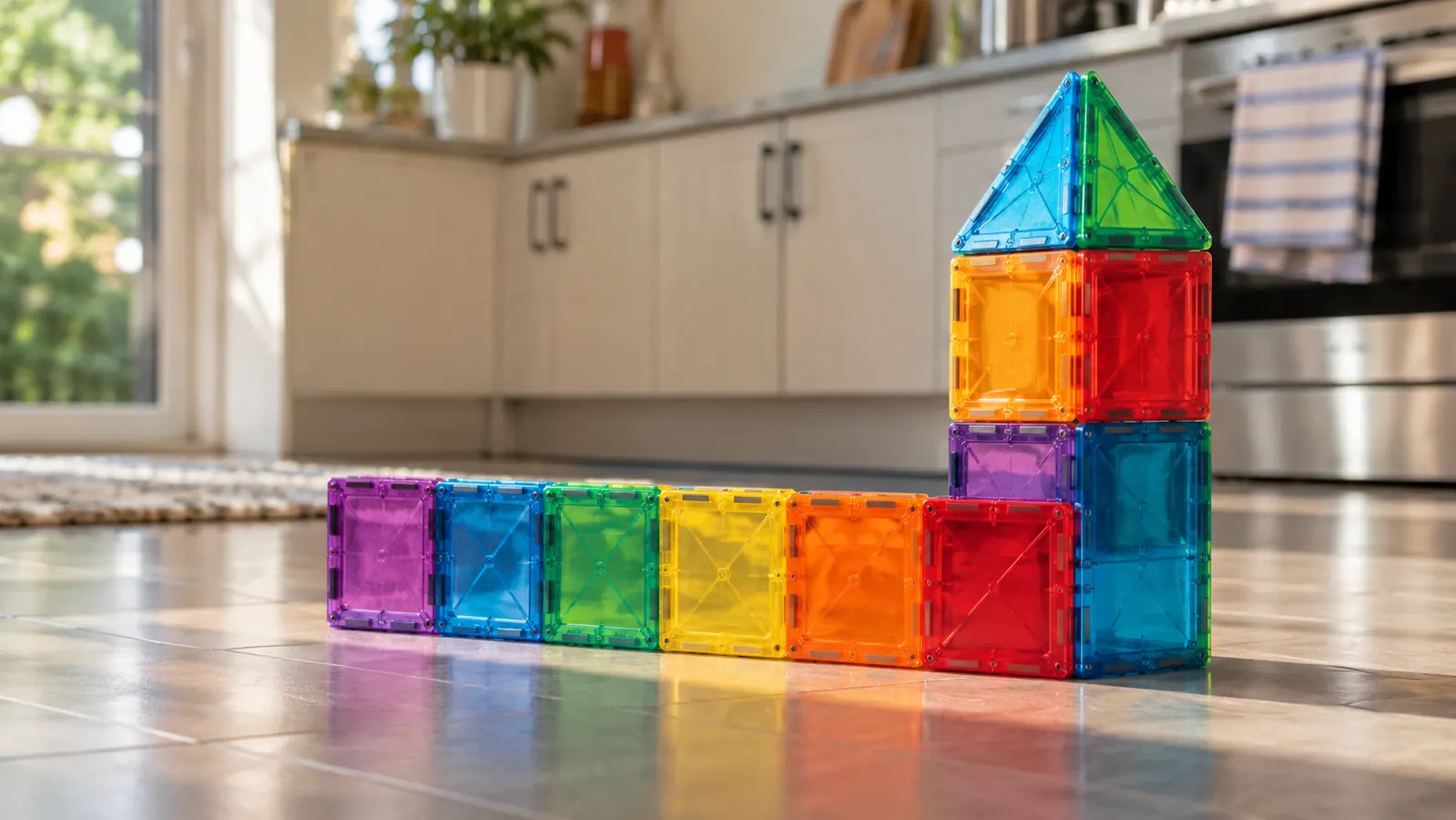
I did not buy these so the children would have something to do in a different room while I got on with my day. I bought them because I wanted something to do with them that did not involve a screen or a rule I had to keep explaining. Mia builds a stage and then a backdrop for it, and then she stands behind it and sings, and the tiles are the set and she is the show. Eli builds as tall as he can and then I build it back up, and that is the entire game, and it can go on for an hour. Neither of them needs me to run it. They just need me to be on the floor.
One Saturday in July, Mia spent the better part of an hour on a backdrop for a song she was going to sing, and she used most of the hundred pieces to do it. It had a low wall across the front with a gap in the middle that she called the door, and a taller section at one end, and she had me hold one side steady while she worked on the other, which is the closest I have come to being a stagehand in my life. Then she sang, and Eli knocked the low wall down halfway through, and she kept singing anyway. I have thought about that afternoon more than once since. The toy did not make the show. The toy just meant we all stayed in the same room for an hour on a Saturday.
That is the thing about a toy like this that the listing will never tell you. It is quiet enough and open enough that a grandmother can sit down in the middle of it and be part of the afternoon instead of the person refereeing it. I have built more than one low wall in my life and knocked down more than one tower, and I would not trade those Saturdays.
What I Liked
- One hundred pieces is genuinely enough for two children building at once
- No batteries, no app, no screen, nothing to charge
- Survived eight months of a four-year-old knocking things down on purpose
- All three grandchildren, ages two to seven, use it in completely different ways
- Fits in a box on the bottom shelf, so the children can get it themselves
- Light enough at 5.5 pounds for a four-year-old to carry
Where It Falls Short
- A two-year-old needs an adult within arm's reach the entire time
- A hundred plastic pieces hitting a hard floor is genuinely loud
- A stepped-on piece can crack along the seam
- A toddler can knock down an older child's build faster than it can be rebuilt
- One hundred pieces means one hundred pieces to pick up
Eight months, one hundred pieces, not one battery. It is the only thing in that room I have never had to talk up.
Who This Is For
This is for the grandparent who wants a toy that gets used instead of admired. If your grandchildren are between about three and eight, if more than one of them visits at the same time, and if you would rather sit on the floor and build than watch somebody else's video, the PicassoTiles set is the one I would point you toward. It is also a good one to mail, because there is no cord, no charging, no setup and nothing for the parents to install. It works the moment the box opens. I would say the same to a parent, an aunt, or anybody who has ever watched a child unwrap something loud and then abandon it by two in the afternoon.
Who Should Skip It
If the child in your life is under three, wait. The label says three and up and I would honor it, especially if the set is going to a house where you will not be the one on the floor. If you are buying for a child who only plays with things that light up and talk, this will sit in the box for a while before it clicks. And if the idea of a hundred small pieces scattered across a kitchen floor makes you tired just reading about it, believe that feeling. Nothing here is heavy, but everything here has to be picked up. Two pieces out of my hundred have hairline cracks from being stepped on, and if that would bother you, this is not the toy for your house.
Eight months of Saturdays, and the box is still on the bottom shelf
One hundred magnetic tiles, ages three and up, no batteries and nothing to charge. If you want a gift that gets used instead of admired, start here.
Amazon Check Today's Price on Amazon →