

Eli is four, and he will not sit still for a toy that makes him wait. That is the short version of why the PicassoTiles 100 Piece Magnetic Tiles set has lived on the bottom shelf of my grandkids' room for eight months, and why the wooden blocks I played with as a girl now sit in a cloth bag one shelf up. I am Glenda Varnell, sixty-six, a retired school office manager in Fort Worth, Texas, and I have three grandchildren: Mia, seven, Eli, four, and Sophie, two. I have bought both kinds of blocks, watched both kinds hit the living-room rug, and swept both kinds into a dustpan. This is the comparison I wish somebody had handed me before I stood in a toy aisle for forty minutes talking to myself.
The short answer: PicassoTiles is the better gift if you want a four-year-old to build something that stands up on the first try, and a seven-year-old to turn the same pieces into a stage for a living-room show. Wooden blocks are better if you want one toy that survives every grandchild, every drop, and every decade, with no magnets to lose and no right way to connect. Magnetic tiles win on speed and spectacle. Wooden blocks win on patience, open-ended play, and the long haul. Most grandparents do not need to choose forever. But if you are buying one gift this month, pick the one that fits the child standing in front of you.
| PicassoTiles Magnetic Tiles | Wooden Blocks | |
|---|---|---|
| What you get | 100 magnetic plastic tiles in geometric shapes, plus an instruction manual. | A loose set of wooden blocks, usually in a cloth bag or a box. |
| Recommended age | Manufacturer recommends 3 years and up. | Chunky blocks work for toddlers under 3; small blocks wait. |
| First build | Tiles pull together and hold a wall or tower right away. | Blocks need balance, so early towers fall. |
| Open-ended play | Tiles make houses, stages, and flat designs, but the magnet sets some limits. | Any block can be anything, with no polarity and no wrong side. |
| Group play | Listed for multiple players; two children can share one build. | Shareable, but one child often claims the good pieces. |
| Durability | Plastic tiles wipe clean and the set is still complete after eight months in my house. | Wooden blocks dent and chip but keep working for decades. |
| Storage | 100 tiles need a bin or the original box; loose tiles spread fast. | Scoops into a bag in seconds. |
| Learning | Shapes, counting, 3D forms, and magnetic polarity. | Balance, gravity, patience, and spatial reasoning. |
| Noise | Tiles click and clack when a build collapses. | Blocks clatter loudly when they fall. |
| Hand-me-down factor | A plastic set can last, but it depends on keeping the pieces together. | A wooden set can pass through three children and still work. |
What the PicassoTiles Set Actually Does
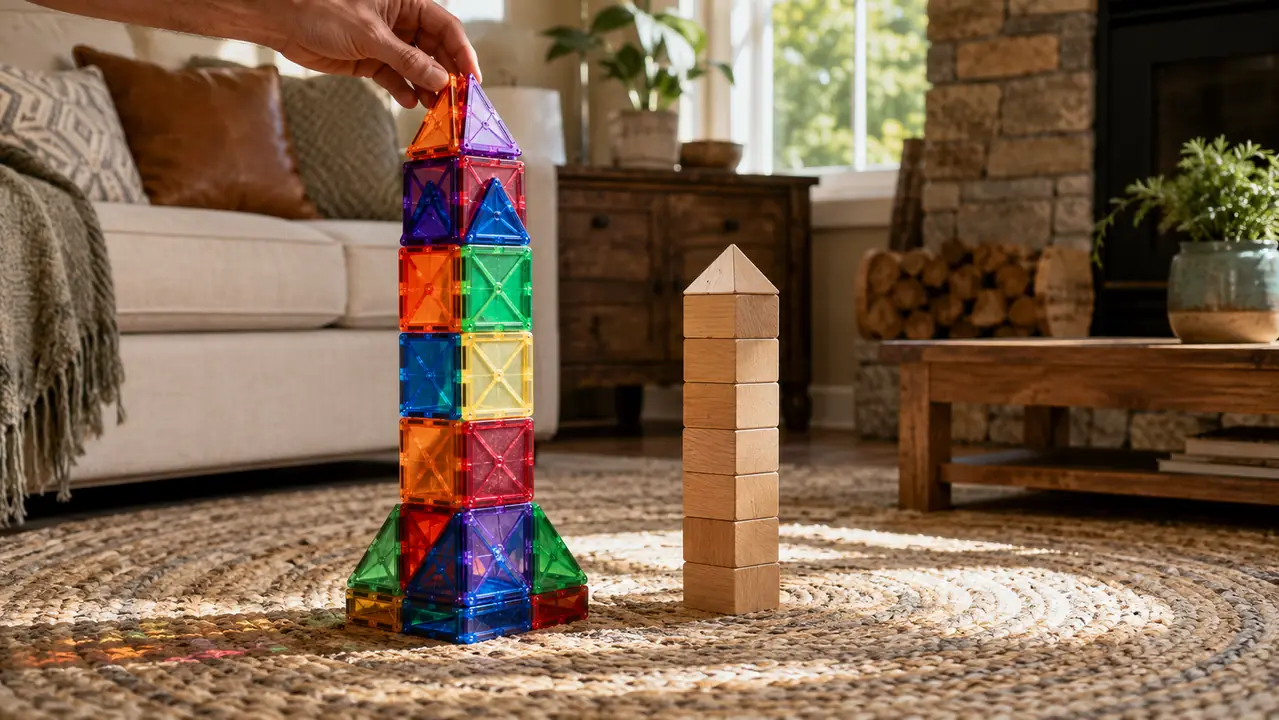
The set is exactly what the name says: 100 plastic magnetic tiles, a 5.5-pound set that measures 14 by 11.63 by 3.13 inches, and an instruction manual. The manufacturer recommends it for ages 3 and up. The tiles are magnetic, so they pull together and hold a shape without glue, clips, or a grown-up holding the walls upright while a child screams at them. The listing talks about geometric shapes, 3D forms, counting, and magnetic polarity, and that matches what I see at my own coffee table. Eli can make a box, a tower, or a garage for his cars in under a minute. Mia uses the same pieces to build a low stage, then drapes a scarf over it and calls it a set. The operation is manual, which means nobody has to hand over a phone or a tablet. That matters a great deal in my house.
I keep one set of 100, not two. The pieces live in a plastic bin in the grandkids' room, which is fine until the bin is empty and the tiles are all over the rug. A 100-piece set is enough for two children to build side by side without a fight, though not enough for a castle with four towers, a garage, and a swimming pool. I have watched Mia and Eli negotiate over the flat pieces like two lawyers. I have also watched them build a single wall together, one tile at a time, which is the closest thing to peace I get on a Saturday afternoon.
Sophie, who is two and lives in Oklahoma City, is not quite the target age. The box says 3 and up. When she visits, I put the tiles on the rug and sit down with her, because a fold of skin can get caught between two tiles. That is not a reason to skip the toy. It is a reason to play with a two-year-old instead of leaving her alone with it. At three and four, Eli is in the sweet spot. At seven, Mia is still building, which says more than I expected when I bought the thing.
Safety and the Age Label
The age label is the first thing I check, and I do not treat it as a suggestion. PicassoTiles puts the set at 3 years and up. Eli was three when he started, and he needed me nearby for the first few weeks. The magnets are part of the play, and magnets deserve respect with small children in the house. I keep the tiles in the grandkids' room, not in a basket by the front door, so Sophie does not find them before I am ready to sit down with her. That is simple housekeeping, not a knock on the toy.
Wooden blocks have an easier safety story. There are no magnets and no polarity, and a basic set has no small parts to worry about. A two-year-old can stack the chunky ones while I watch, and a four-year-old can build a road across the kitchen floor. The tradeoff is that a wooden block hurts more when it lands on a bare foot, and a tall tower makes a louder crash. I have stepped on both. I would rather step on a plastic tile, but I would rather clean up a bag of blocks. That is the kind of trade this whole comparison comes down to.
Where PicassoTiles Wins
Speed is the first win. A wooden block tower asks a child to balance one piece on another, and a four-year-old's hands are not always steady. Eli built with wooden blocks for about three minutes before he knocked the tower down on purpose and walked away. With the PicassoTiles set, he gets a wall, a roof, and a door in the time it takes me to fill a glass of water. The magnets do the holding, so his ideas do not collapse before he can finish them. That sounds like a small thing. For a busy child, it is the difference between playing and quitting.
The second win is the way the tiles pull two ages together. Mia is seven and wants a stage. Eli is four and wants a garage. They can build both from the same 100 pieces, and Mia can show Eli how to make a corner that holds. The set is listed for multiple players, and that is accurate in my experience. On a Saturday afternoon I have seen a seven-year-old and a four-year-old sit shoulder to shoulder for twenty minutes, which is a long stretch in my living room. Wooden blocks can do that too, but the collapse rate is higher, and the tears come faster.
The third win is the shape of the play itself. Tiles stack flat, so a build fits on a coffee table or a lap tray, and the whole thing goes back in a bin at the end. That matters to me more than it would to a young parent. I am not getting down on the floor for an hour anymore. I can sit in my rocking chair with a cup of coffee and watch a garage go up six feet away, and I can hand over a tile without rearranging my whole afternoon. Eli brings the pieces to me when he wants a wall held steady, and then he does not need me at all.
Where Wooden Blocks Win
Wooden blocks win the long game. They do not have magnets to loosen, polarity to fight, or a specific way to connect. A block is a block. Sophie can stack two chunky blocks at two years old, and there is no wrong side to find. Eli can line them up as a train, and Mia can use them as furniture for a dollhouse. The toy does not decide what it is. That is the kind of open-ended play that makes a toy last through three children and then a box in the attic. It asks more of the child, and it gives more back.
Wooden blocks also win on durability. They clatter when they fall, and they will dent a baseboard, but they survive. A wooden block does not lose its hold because one piece is turned the wrong way. When a tower falls, the child learns that the next tower needs a wider base. That lesson is slower and louder, but it sticks in a way a magnet never will. The PicassoTiles set gives a child a fast win. Wooden blocks give a child a skill. I have a cloth bag of blocks that belonged to my own children, and they are nicked and one is missing a corner, and they still work just fine.
If You Want the Build That Holds on the First Try, Start Here
The 100-piece PicassoTiles set is the one my four-year-old grandson reaches for on Saturday mornings. It is rated for ages 3 and up, it wipes clean, and it gives two children a shared project without a screen. I bought mine eight months ago and it is still on the shelf.
Amazon See the PicassoTiles Set on Amazon →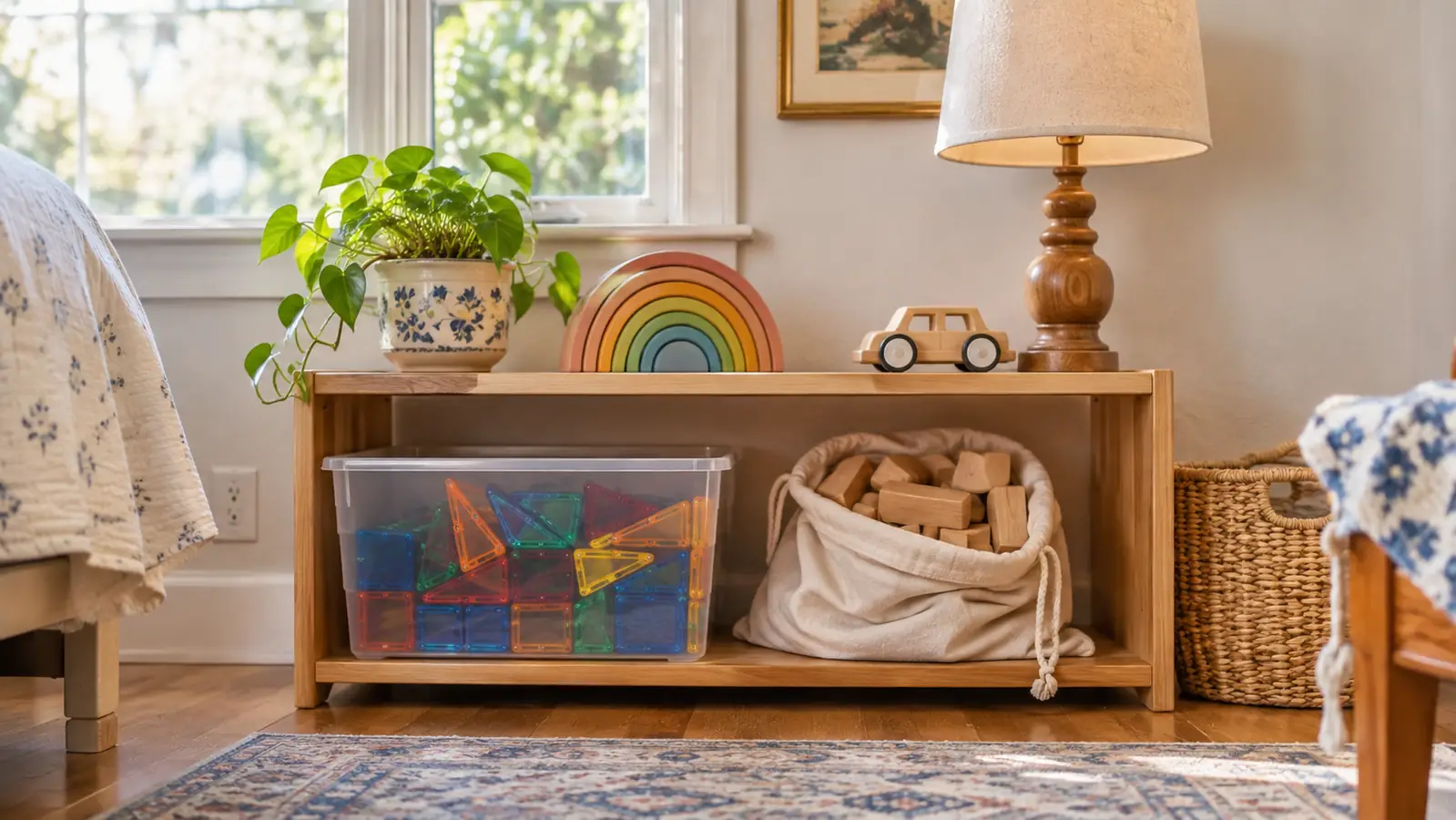
Storage, Cleanup, and the Parts That Wander Off
I am going to be honest about the part nobody mentions in the reviews. A hundred magnetic tiles make a hundred small decisions at cleanup time, and Eli is four, so those decisions are mine. The set came in its own box, and for the first month I tried to keep it there. That lasted about two weeks. Now the tiles live in a plastic bin with a lid, and the bin lives on the bottom shelf where Eli can reach it himself. One bin, one lid, one minute. If you keep the original box, keep it somewhere the child cannot flatten it, because a flattened box means loose tiles in a drawer forever.
Wooden blocks win cleanup without much of a contest. I hold the bag open, and the blocks go in. No sorting, no counting, no hunting under the couch for the one piece that makes the roof work. That matters more as I get older and my knees are less interested in the floor. I have crawled under the piano for a magnetic tile exactly once, and I would like to keep that number at one. If you are buying for a house where cleanup happens at nine at night after everybody has gone home, that is worth thinking about.
The Afternoon That Decided It
One rainy Saturday in March, my daughter Rachel dropped off Mia and Eli for the afternoon. Eli wanted to build a garage. Mia wanted a stage. I had one set of 100 PicassoTiles and one bag of wooden blocks, and I did not want to referee a toy dispute. So I put the tiles on the rug and the blocks on the kitchen floor and told them they could switch whenever they wanted. Eli started with the tiles. Mia started with the blocks. Ten minutes later, both were on the rug, and the wooden blocks had become a parking lot for the cars that went into the tile garage. That is the honest picture. These two toys are not enemies. They do different jobs, and a good afternoon uses both.
The tiles gave Eli a garage with a roof that stayed on. The blocks gave Mia a ramp for the cars to roll down. The garage collapsed twice, and Eli rebuilt it twice without a meltdown. The ramp collapsed once, and Mia rebuilt it with a wider base and told me she had solved it. I sat in the rocking chair and did not touch my phone for nearly an hour. That is the test I use now. Which toy keeps them busy without me managing the play? That afternoon the answer was both, but the tiles started the engine and the blocks taught the lesson.
The tiles gave Eli a garage that stayed put. The blocks gave Mia a ramp and a lesson about a wider base. The best afternoons used both.
What About the Grandchild Who Lives Far Away?
Sophie is three hours away in Oklahoma City, so I buy differently for her. I shipped her a wooden stacker last spring, and I have watched her work at it on video calls with her daddy holding the phone at an angle that makes me dizzy. A wooden toy travels well because there is nothing to lose and nothing to charge. If I were mailing her the PicassoTiles set, I would think about the box first. It weighs 5.5 pounds and arrives as one package, which is fine, but the pieces need somewhere to live once they are out. I would send a bin with it or tell my son to clear a shelf before it lands.
Here is the part I did not expect. Sophie is too young for the tiles by the label, but she is not too young to be in the room while they are out. When she visits, she sits on my lap and hands me tiles one at a time while Eli builds. She is learning the shapes and the colors from the edge of the action, and it costs me nothing to include her. Wooden blocks let her get her hands dirty sooner. Magnetic tiles let her join the older two sooner. Both are worth having if you keep grandchildren of different ages under one roof.
Who Should Buy Which
Buy the PicassoTiles set if your grandchild is three or older, likes to build fast, and gets frustrated when a tower falls before it is finished. Buy it if two children close in age will share it, or if you want a toy that moves from the rug to the kitchen floor without a screen and without batteries. The 100-piece set is enough for one good build at a time, and it is enough for two children to share with some coaching. It is not enough for a whole city. If your grandchild is a planner who wants to build for an hour, start with 100 and see whether the interest holds before you add anything.
Buy wooden blocks if your grandchild is two or three and still puts things in their mouth, or if you want a toy that will survive every child in the family and then some. Buy them if the child likes to line up, stack, and knock down without a magnet deciding which way the pieces go. A basic set of wooden blocks is lighter on the rules and harder on the toes. It is the better first building toy, and it is the better hand-me-down. It is not the better toy for a child who wants a wall to stay up on the first try, and pretending otherwise would not help anybody.
Buy both if you have the room and the grandchildren visit often. They do different jobs, and that rainy afternoon worked because each child could choose. If you are mailing a gift to a grandchild who lives three hours away, the PicassoTiles set weighs 5.5 pounds and arrives as one box. Wooden blocks are easier to add to over time, one small set at a birthday, which suits a grandchild you see once a month. I would not buy a second 100-piece set until the first one is actually being used. One set tells you whether you are raising a builder, and one set is plenty to find out.
For the Grandchild Who Wants to Build It Now, This Is the Set I Would Buy Again
The PicassoTiles 100-piece set is still on the bottom shelf at my house, and it still gets used on Saturdays. If your grandchild is three or older and wants a build that holds, start here.
Amazon See the PicassoTiles Set on Amazon →