
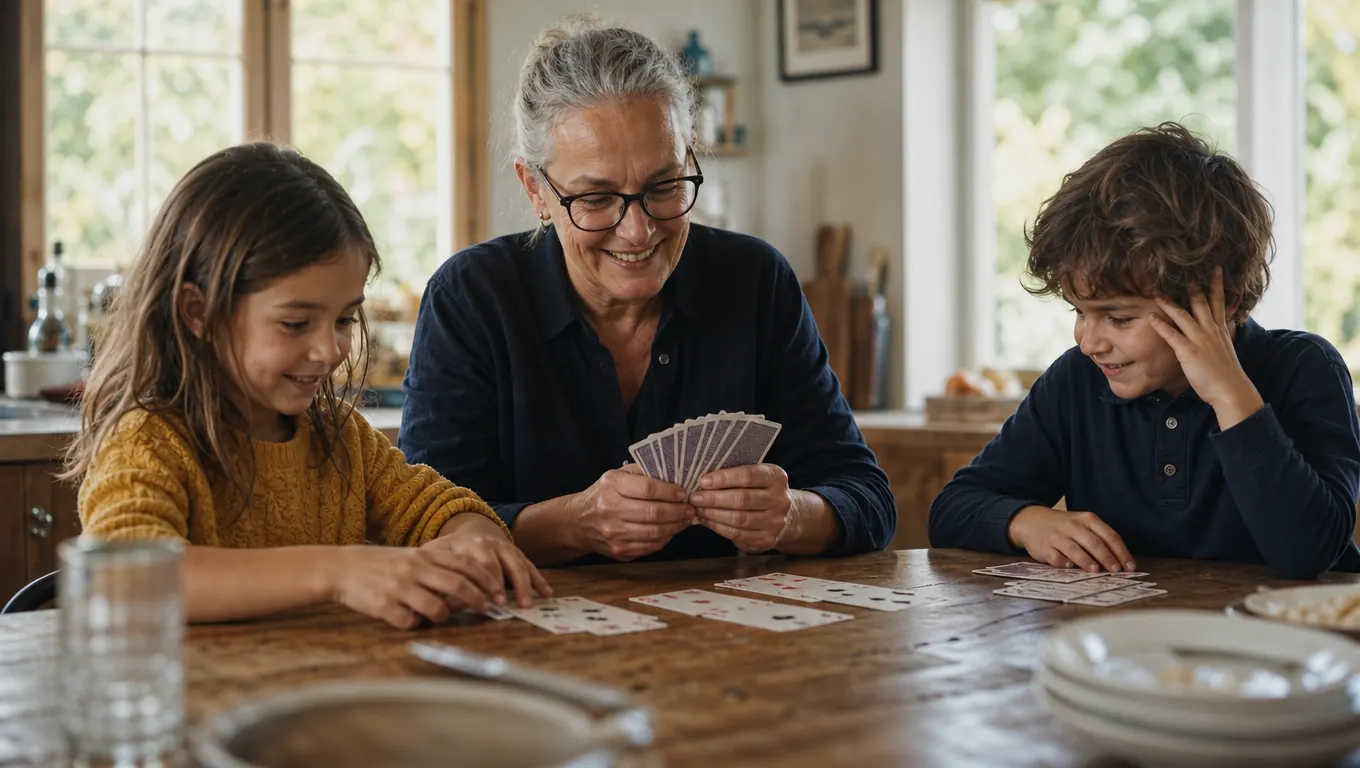
Here is what usually happens when I buy a gift for my grandchildren. They open it, they are thrilled, they play with it for one Saturday afternoon, and by the next visit it is on the floor of the grandkids' room with three pieces missing and nobody able to remember the rules. I have bought a great many of those. The Regal Games Card Games for Kids tin is the exception, and the reason is embarrassingly simple. It does not live on a shelf. It lives in my purse. Six little decks in a tin small enough for a cardigan pocket, and it has gone everywhere with me for about a year and a half now.
I am 66, retired from the front office of a Fort Worth elementary school, and I keep three grandchildren in rotation. Mia is 7 and puts on living-room shows with costumes and a karaoke microphone. Eli is 4, loud, and builds things specifically so he can knock them down. Sophie is 2 and lives in Oklahoma City, three hours up the interstate, so I see her about once a month and mail her things in between. I did not buy this tin as a gift for any one of them. I bought it for my own kitchen table, which turned out to be the smarter purchase.
The Quick Verdict
The one game in my house that survives a restaurant, a waiting room and a 4-year-old. The cards do not love being slapped, and your hands will notice how small they are.
Amazon Check Today's Price →Six decks that fit in a purse and work in a waiting room
Go Fish, Crazy 8's, Old Maid, Slap Jack, War and a memory game in one small tin. No batteries, no app, nothing to charge. See today's price on Amazon.
Amazon Check Today's Price on Amazon →How I've Used It
I bought the tin a year and a half ago, before a Saturday when Mia and Eli were coming over and the afternoon had that stretched-out feeling that ends with somebody crying. I put it on the kitchen table after lunch, cleared the plates, and dealt Go Fish. We played for forty minutes. Forty minutes is a very long time in the life of a 4-year-old, and Eli was still in his chair at the end of it, which tells you most of what you need to know.
Since then it has gone with me to two restaurants where the food took too long, one doctor's waiting room where we sat for an hour and ten minutes, and the three-hour drive up to see Sophie. That last one matters most to me. Sophie is small and the drive is long and there is a stretch past Gainesville where everybody in the car runs out of patience at the same time. Mia and Eli can play War in the back seat with the cards stacked on a book between them, and I get twenty more minutes of quiet than I used to.
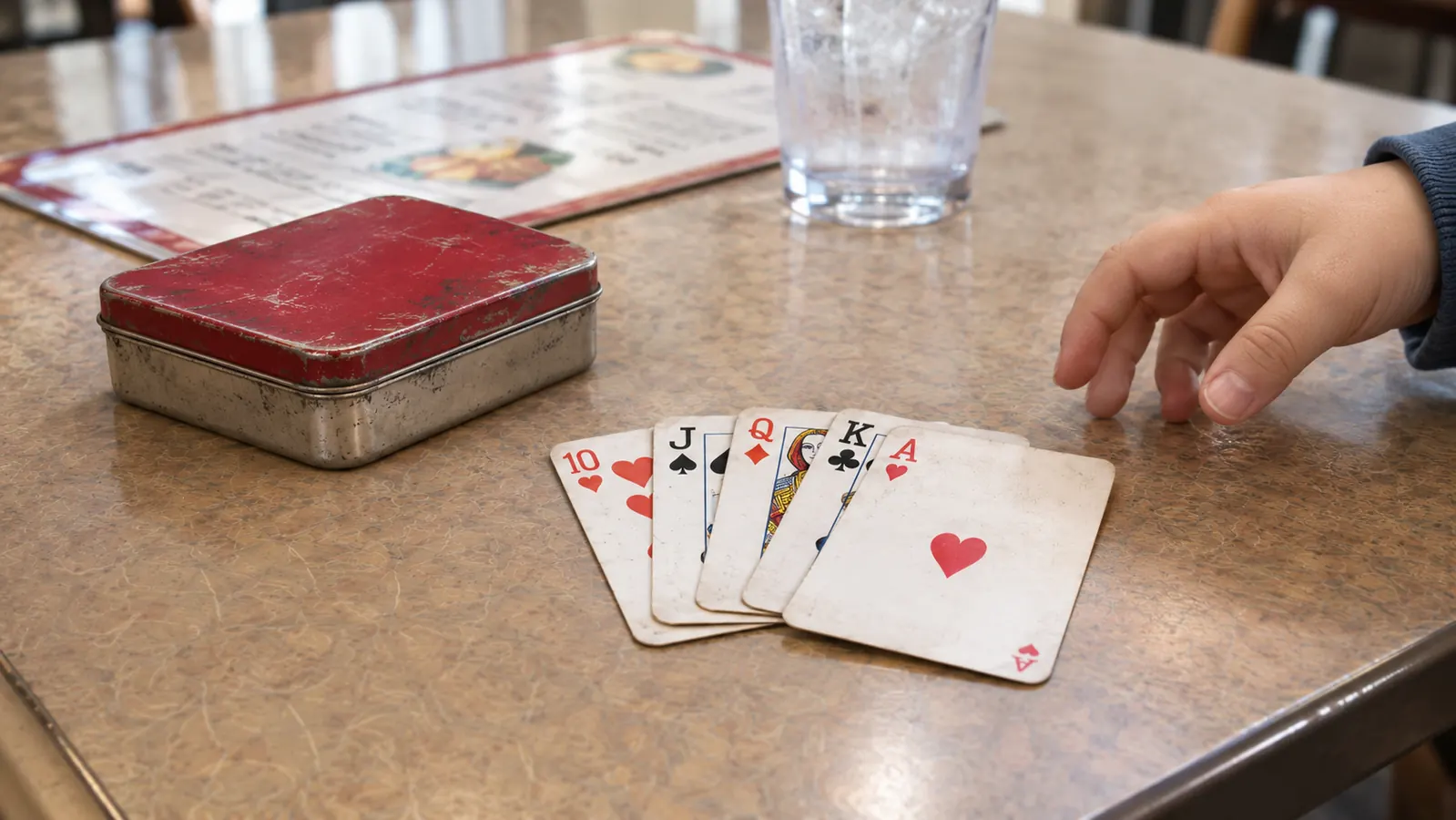
The waiting room was a Tuesday in March, a checkup that ran an hour past its slot, and I had already used up the crackers and the two broken crayons at the bottom of my bag. We played Go Fish on the seat between us, laying the cards out in a grid because there was no table to stack them on, and a woman two chairs down told me her own mother used to keep a deck in her apron pocket. That is the sort of thing this tin does. It turns a bad hour into an ordinary one, and nobody in the room had to listen to a cartoon on full volume.
At my table the division of labor is settled. Eli wants Slap Jack, which is essentially a sanctioned excuse to hit the table with an open hand. Mia wants Old Maid, and she wants it played properly, with the faces carefully kept so nobody can see who is holding the old maid. I like Crazy 8's myself, because it is the one where you can watch a child do two things at once, match a number and choose a suit, and see the little gears turning behind her eyes.
What Is Actually in the Tin
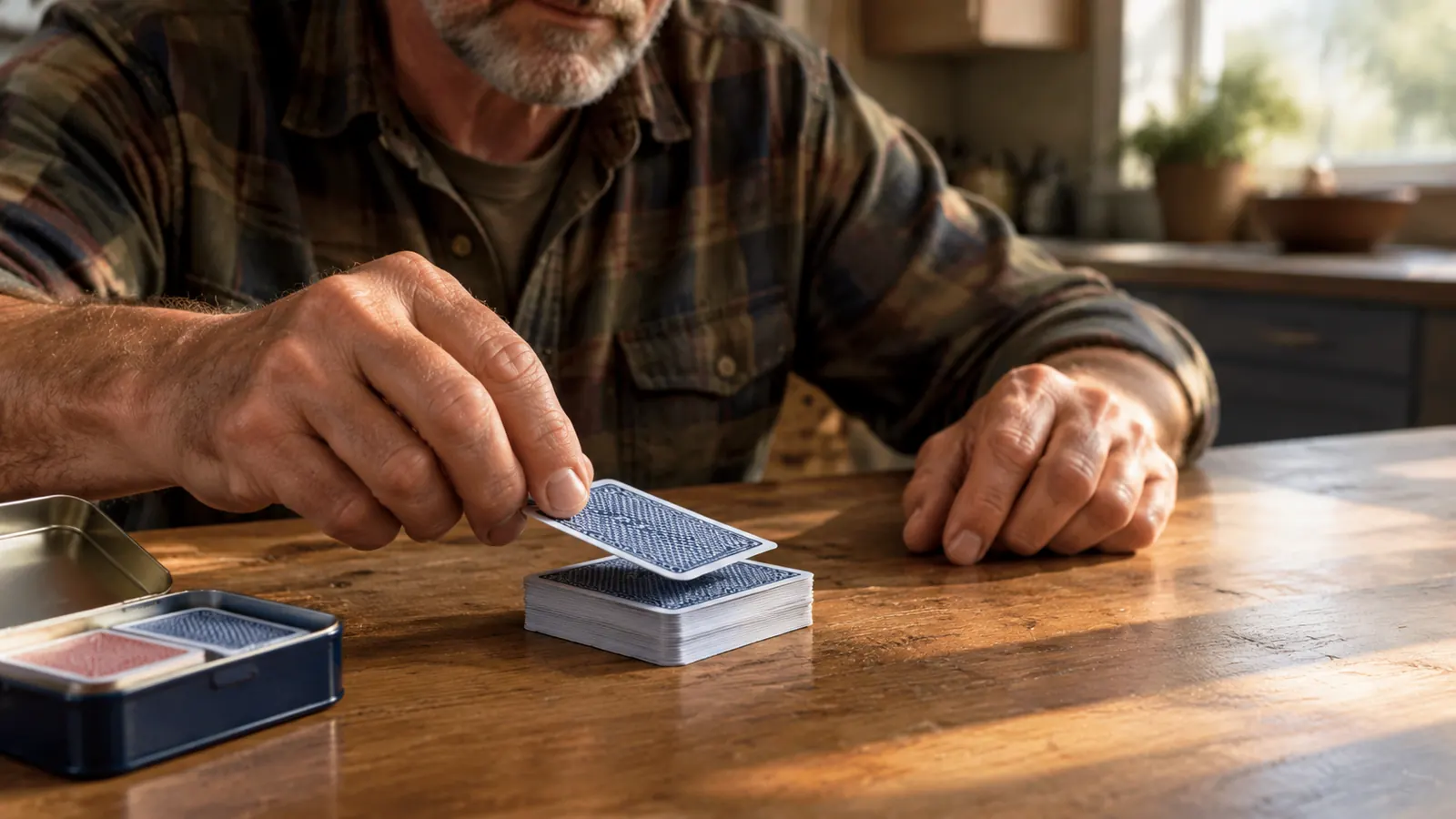
Six decks, packed in a tin that measures about four inches by two and a half inches and weighs eight ounces. The games are Go Fish, Crazy 8's, Old Maid, Slap Jack, War, and a memory game that the listing calls Silly Monster Memory while the title on the same page calls it Garbage Monster. That naming drift is the sort of thing that makes a grandparent squint at her phone, so let me say it plainly. It is the matching-and-remembering game, whatever the lid says, and the listing notes that the exact assortment may vary from tin to tin.
I will tell you how mine arrived, since the listing warns that the assortment can vary. My tin had all six, and the memory game came with the monster artwork that the title names, which told me the two names on the page are the same game in two different printings. If you are ordering this for a child who has set her heart on one particular game, order early enough that you can open the tin and look inside before you wrap it. I checked mine on the kitchen counter the day it came and then put it back together with the decks in the order they arrived, which lasted about one visit.
Each deck is built for 2 to 6 players and Regal Games puts the age range at 4 to 12. That range is honest, and it is wider than most. Four is the floor for a reason. A 4-year-old can play Go Fish by matching numbers and colors, and can play Slap Jack purely on reflexes, but he cannot play War without an adult sitting next to him counting. Twelve is the ceiling for a different reason. A 12-year-old will happily play these with a younger cousin and enjoy it, but will not go get the tin on his own.
The cards are plastic rather than paper, which I did not fully appreciate until the first time a glass of sweet tea went over on the table. I wiped them down, fanned them, and we kept playing. The listing mentions learning colors, numbers, reading skills, memory and matching, and I would not oversell any of that. This is not a curriculum. It is a deck of cards that happens to make a child hold numbered symbols in his head for an hour and pay attention to what somebody else is doing, which is not nothing.
How It Plays With a 7-Year-Old and a 4-Year-Old
Go Fish is the one I would hand to anybody starting out. The rules fit in a sentence, the cards carry big clear symbols, and a 4-year-old can play a whole hand without being coached. Eli asks for cards by number and gets it right maybe two-thirds of the time, and the other third he is guessing, and the game does not care. It keeps moving, which is the whole trick with a boy that age.
Old Maid is Mia's game, and it taught me something about her. She is 7 and she is already good at the poker face, holding four cards so the matching pair stays hidden, watching my eyes while I choose. She beat me four hands in a row one afternoon and I am not entirely convinced she was cheating, which is somehow worse.
Slap Jack belongs to Eli and it is loud. The first Saturday we played it, he slapped so hard that the whole stack jumped and three cards sailed off the end of the table and under the refrigerator. We fished them out with a broom handle and a good deal of commentary from Mia. Now we play with the stack in the middle and a house rule that if a card leaves the table the hand is over and the offender picks it up. He is 4, so he considers the retrieving part of the game and does it with great ceremony.
The plastic coating takes that kind of abuse, but the cards still bend, and after a year and a half the Slap Jack deck is the one that looks its age, with a soft corner and one card carrying a crease across the face. He is 4. There is no version of this where the cards stay flat. War is the one I would save for later. It works with Mia, who can compare numbers fast, and it drags with Eli, who loses interest somewhere around the fourth hand and starts building a tower out of the discards.
It has been in my purse for a year and a half. It has come out in a restaurant, a waiting room and a back seat, and it has never once failed to hold the table.
What Has Held Up and What Has Not
The tin has a dent in the lid from being dropped in a parking lot. It still closes. All six decks are complete, which surprises me given how much Slap Jack this tin has seen. The coating has scuffed on the face cards of the Old Maid deck, and the old maid herself now carries a crease across one corner, which Mia finds hilarious and points out every single time we play. Nothing has been lost. Nothing has been torn in half. That is a better record than anything else on the toy shelf.
The deck that gets used least is War, and it is also the one in the best shape, which tells you something about how this whole set wears. The damage tracks exactly where the children's attention goes. Slap Jack is soft at the corners because a 4-year-old hits it. Old Maid is scuffed on the face cards because Mia shuffles it herself and does not shuffle gently. War looks like it came out of the wrapper last month. If you are buying this for one quiet child who likes matching games, your tin will look new for years. Buy it for a slapper and it will not.
The honest complaint is the size. Four inches by two and a half inches is a small tin, which means small cards, which means my 66-year-old hands fan them awkwardly and Eli's 4-year-old hands can barely manage five at once. It is the tradeoff that makes the whole thing work, because a bigger deck would never live in my purse, but it is a real tradeoff and I notice it every time we play on a table with a slick top. If you have arthritis in your thumbs, buy this for the child and expect to be the one holding the tin open.
The other thing I will say plainly is that six decks in one tin means six decks you have to keep sorted. If your grandchildren are the sort who dump everything out and stir it with a hand, you will spend a Sunday evening sorting War from Crazy 8's. Mine are mostly past that now. I have still sorted cards at ten at night, and I did not enjoy it.
How It Stacks Up Against Everything Else on My Toy Shelf
I have the spare bedroom set up with a shelf, and I have bought enough over the years to know what survives there. The magnetic tiles get built with and knocked down and built again, and they have earned their space. The karaoke machine earns its space on Saturdays when Mia wants to put on a show for an audience of one. The Regal Games tin earns its space on a completely different schedule, because it is the only one of the three that leaves the house. Tiles do not go to a restaurant. A karaoke machine does not go to a doctor's office. The tin goes everywhere, and that is the entire case for it.
Against a board game, it wins on setup and on tidiness. There is no board to unfold, no spinner to lose, no box lid that refuses to shut once the plastic insert is torn. Against a tablet, it wins because the four of you are looking at each other instead of at a screen. I want to be fair, though. A board game gives you more to do across a whole rainy afternoon. This tin gives you twenty good minutes in a place where you would otherwise have had a meltdown, and then it goes back in your purse and does it again next week.
I have also sent gifts through the mail that arrived cracked, crushed, or missing the one piece that made them worth having, so I will say this for the tin. It weighs eight ounces, it is four inches across, and it survives a padded envelope and a delivery truck. When I mail something to Sophie in Oklahoma City, I want it to arrive in one piece and I want her father to be able to open it without a screwdriver. A tin of cards does both.
What I Liked
- Six complete decks in one tin that fits in a purse or a glove box
- A 4-year-old can genuinely play Go Fish and Slap Jack without help
- Plastic-coated cards survive spilled drinks and one slap too many
- The 4 to 12 age range still works when an older cousin visits
- No batteries, no app, nothing to charge or update
Where It Falls Short
- Small cards, awkward in older hands and hard for little ones to fan
- Six decks means sorting, and somebody will mix them
- The Slap Jack deck creases within months in the hands of a 4-year-old
- A 12-year-old will play along with a younger cousin but will not ask for it
- The listing itself is inconsistent about one game's name
Who This Is For
This is for the grandparent with a purse or a glove box and a grandchild somewhere between 4 and 8. It is for the one who ends up waiting, in a booth, in a lobby, in a car, with a child who has run out of things to do and is starting to slide under the table. It is for the grandparent who would rather be doing something with the child than handing over a screen in a restaurant. And it is for the one shopping from a distance, because a tin eight ounces light and four inches across mails easily and arrives intact, which is more than I can say for most of what I have sent Sophie.
Who Should Skip It
Skip it if your grandchildren are 10 and up and only see each other twice a year. They will play one hand to be polite and then reach for their phones. Skip it if you want a gift that announces itself, because this is a small tin that looks like nothing under wrapping paper and will get a lukewarm face from a child who was hoping for something bigger. Skip it if nobody in the house likes losing, because Slap Jack and War are both games where somebody loses over and over and out loud. And skip it if you are not willing to sit down and play. A deck of cards in a tin is not entertainment on its own. It is entertainment because you are in the chair across the table.
The gift that lives in your purse, not on the shelf
Six classic decks in one small tin, for 2 to 6 players, ages 4 to 12. It has been in my bag for a year and a half and every card is still there. See today's price on Amazon.
Amazon Check Today's Price on Amazon →