
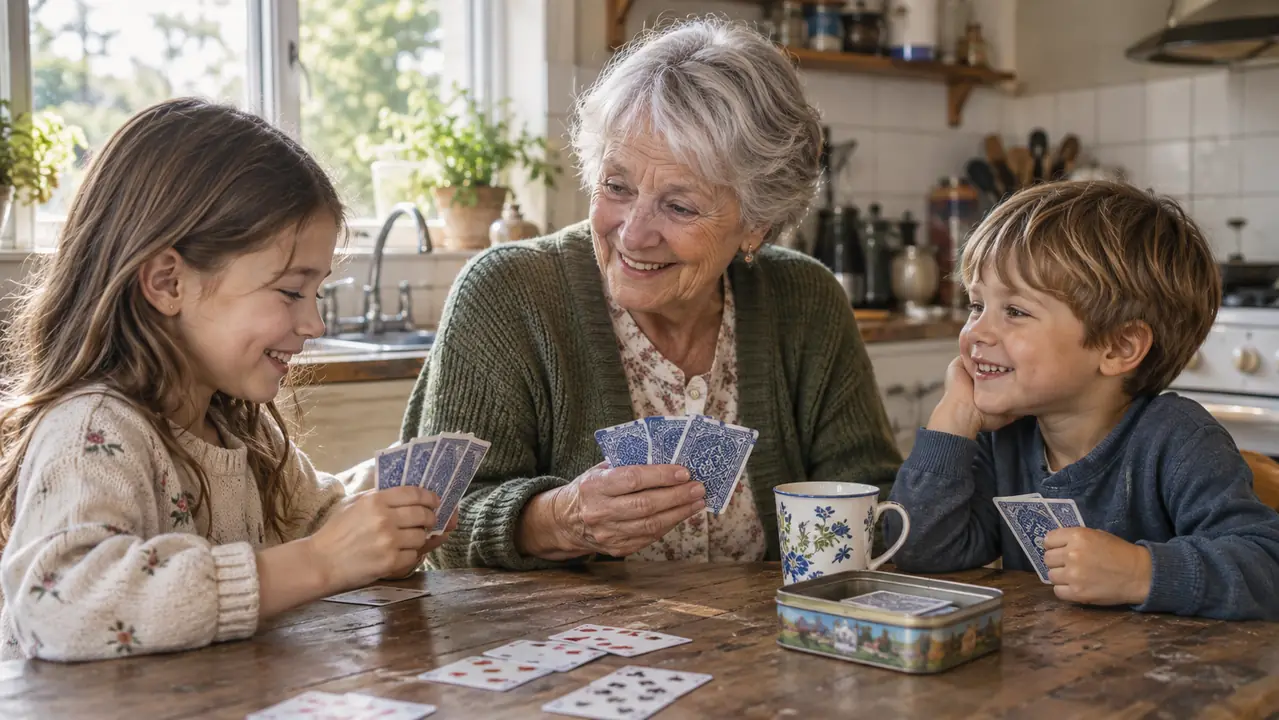
Short answer first, the way my granddaughter Mia would want it: for the way grandparents actually see their grandkids, the Regal Games Card Games for Kids tin wins, and it is not especially close. The board games still have a job. It is just a smaller job than the shelf space suggests. I bought that tin about a year and a half ago, and it has lived in my purse or the kitchen drawer ever since, which is more than I can say for most of what sits on the toy shelf in my spare bedroom.
Here is the honest version. A board game is a planned event. You get it down, you set it up, you play it, you put it away, and everybody has to be in the mood at the same moment. A card game is what happens while the spaghetti is still on the plates. With a 7-year-old, a 4-year-old and a 2-year-old in the family, that difference decides almost everything. So here is how I would sort the two if you handed me a grandchild, an afternoon and a question about which one to buy.
| Regal Games Card Games for Kids | Candy Land (board game) | |
|---|---|---|
| Setup | Shuffle and deal. Ten seconds, no insert, no bag of pieces to open. | Unfold the board, sort the card pile, hope nothing went missing since last time. |
| Where you can play | Kitchen table, restaurant booth, waiting room chair, back seat of a car. | Needs a flat surface wide enough for the board and room for everyone to sit around it. |
| Travel | A tin about four inches by two and a half inches, eight ounces, drops into a purse. | The box does not fit in a purse, and a folded board does not survive a car floor. |
| Players | Two to six players, according to the tin. | A smaller group, and the game assumes everyone sits still at once. |
| Youngest player | Four to twelve years on the package, so my 2-year-old is out for now. | Playable by a child who knows colors and cannot read a word. |
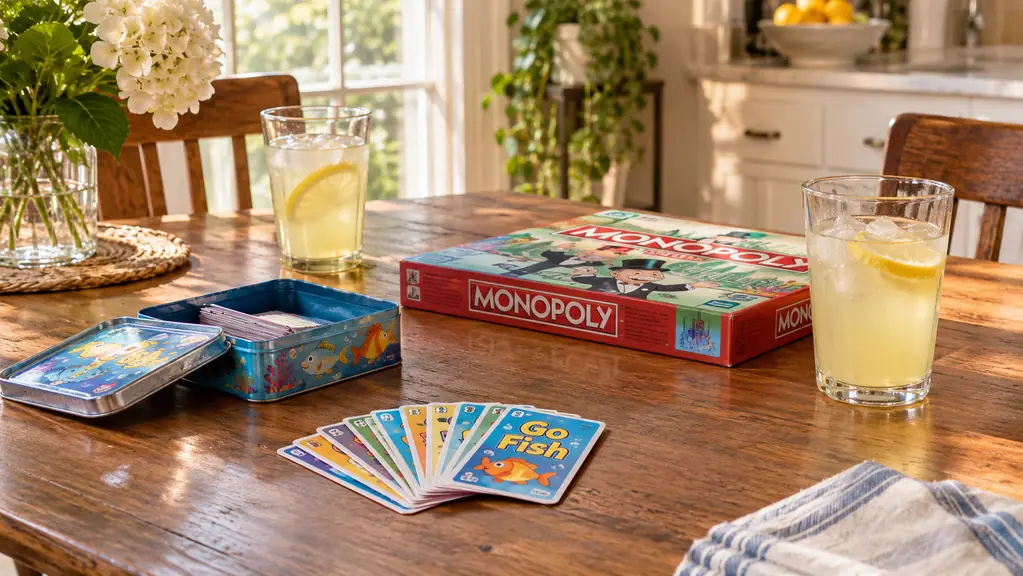
| Games in one box | Six decks: Go Fish, Crazy 8s, Old Maid, Slap Jack, Garbage Monster and War. | One game and one set of rules, every single time. |
| Gift day | A small tin. It does not make a child gasp on Christmas morning. | A big box a child can spot from across the room. |
| Cleanup | Deck back in the tin, lid on, done. | Board, cards, and whatever the toddler scattered on the way through. |
| Numbers and reading | Crazy 8s and War put numbers, matching and suit names in front of a child without a worksheet. | Colors and matching, with almost no number work. |
Where Regal Games Card Games for Kids Wins
The tin itself is the argument. It measures about four inches by two and a half inches and weighs eight ounces, so it disappears into a purse in a way a board game never will. Mine has been to a barbecue place over on Camp Bowie, to a doctor's waiting room on a Tuesday morning, and to the back seat of my car for the three-hour drive up to Oklahoma City to see Sophie. There is no board to balance on a lap and no pieces to chase under a chair when the nurse calls your name. It travels because it can.
Setup is a shuffle and a deal. That is the whole ritual. With a board game there is the box, the insert, the little bag of pieces, the board, the rules, and the child who has already lost interest by the time the second bag is open. Mia is 7, so she shuffles badly and deals crooked and it is still over inside a minute. Eli is 4, and a four-year-old's patience is measured in seconds rather than minutes. The tin respects that in a way a board game cannot.
Six decks in one small tin is the other reason it wins. Go Fish, Crazy 8s, Old Maid, Slap Jack, Garbage Monster and War. Eli's favorite is Slap Jack, which tells you everything you need to know about Eli. Mia's is Old Maid, partly for the drama and partly because she has learned to keep a straight face, which at 7 is a genuine accomplishment. A board game gives you one game. This gives you six, and you can change your mind between hands without anybody having to clean up first.
The learning side is real but quiet. The package lists colors, numbers, reading skills, memory and matching, and that is about what I see at my table. Mia reads the number cards in War out loud without being asked. Eli matches suits in Go Fish and has no idea he is doing arithmetic. Nobody is being taught anything. They are playing, and the numbers come along for the ride. I spent thirty years behind the front desk at a school, and I will tell you plainly that a happy child learns more in twenty minutes than a bored one learns in an hour.
Turn taking was the part I did not expect. A card game forces a child to wait, to watch, and to lose in front of people who love him. Eli had a rough start with that. He swept a hand of cards off the table once, and I sent him out to the back porch to cool off for two minutes, and then we tried again. Now he says good game most of the time. That is not nothing. It is a skill he will use at every job he ever has, and he is learning it over a deck of Old Maid.
One more advantage, and it is the plainest one. The tin costs almost nothing to try, holds up to a crowd, and does not require me to be the entertainment. When all three grandchildren are in the house and Rachel is in the kitchen with me, the card tin gives the older two something to do that is not a screen and not a fight. Two to six players means I can deal in whoever wanders through. A board game with a fixed player count and a long setup cannot flex like that.
Where Candy Land Wins
Now the part where board games win, because they do win some of it. Sophie is 2, and the card tin says four to twelve years on the package. I am not going to hand a two-year-old a hand of cards and pretend otherwise. At my son Daniel's house in Oklahoma City there is a Candy Land box, and it asks for colors and matching and nothing else, no reading, no counting, no bluffing. A child who cannot read a word can play it with an adult. That is a real advantage and I will not talk it down to make my own purchase look smarter.
The second thing board games do better is arrive. A board game is a present. It has a big box with a picture on the front, and a child can see it from across the room on Christmas morning and know exactly what it is. The Regal Games tin is small and unassuming, and if I handed it to Mia wrapped in paper she would thank me politely and then go looking for the bigger box. That is a real cost if the gift itself is the point of the visit.
Board games also scale up. When Mia is 9 or 10, the tin will still work, but the games she will want are longer and louder and involve pretend money and property. A card game does not teach a child to sit at a table for forty-five minutes. A board game does. If your grandchild has already moved past picture cards and wants rules that take a full page to explain, the board game shelf is where your money should go.
The one that lives in my purse, not on the shelf
Six decks, ages four to twelve, two to six players, and a tin small enough that I forget it is in there until the pasta arrives. This is the set I would replace first if I ever lost it.
Amazon Check Today's Price on Amazon →What a Saturday Afternoon Actually Looks Like
Mia and Eli come over most Saturdays, about twenty minutes from Arlington. We eat lunch at the kitchen table, then I clear the plates and reach into the drawer. Eli grabs Slap Jack before I have the lid all the way off. Mia negotiates for Old Maid. We play three or four hands, somebody gets loud or somebody gets bored, and it ends on its own. Nobody has to put a board away. Nobody has to hunt for the one missing piece. Call it twenty-five minutes out of my week, and it is the twenty-five minutes I would keep if I could only keep one.
Old Maid with Mia is my favorite. She has a tell, which I will not describe here, because she reads over my shoulder when she visits. Crazy 8s is the one that teaches the most, because the child has to hold a hand, choose, change the suit and think one step ahead of the person across from her. War is the simplest and it teaches patience with losing, since you lose and lose and then win it all back in three cards. Garbage Monster is the silliest, and silly is sometimes exactly what a rainy Tuesday needs.
There is also music in our house, so the card table is never quiet for long. Somebody hums, somebody drums the table between turns, and I have been known to put an Elvis record on while we play. Mia will sing whatever she is losing to. Eli slaps the table on the beat whether it is his turn or not. A board game asks for a hush. A card game tolerates a kitchen with music in it, and around here that is a point in its favor.
Sophie is harder, because she is 2 and three hours away. I mailed her a wooden stacker, and I will not pretend a card tin is the right gift for her this year. What I do instead is put the tin in my bag when I drive up, so that when she is old enough to sit through a hand of Go Fish it is already there and already familiar. Until then she sits on my lap and hands me cards one at a time and I say thank you, and around here that counts as playing.
The Waiting Room Test
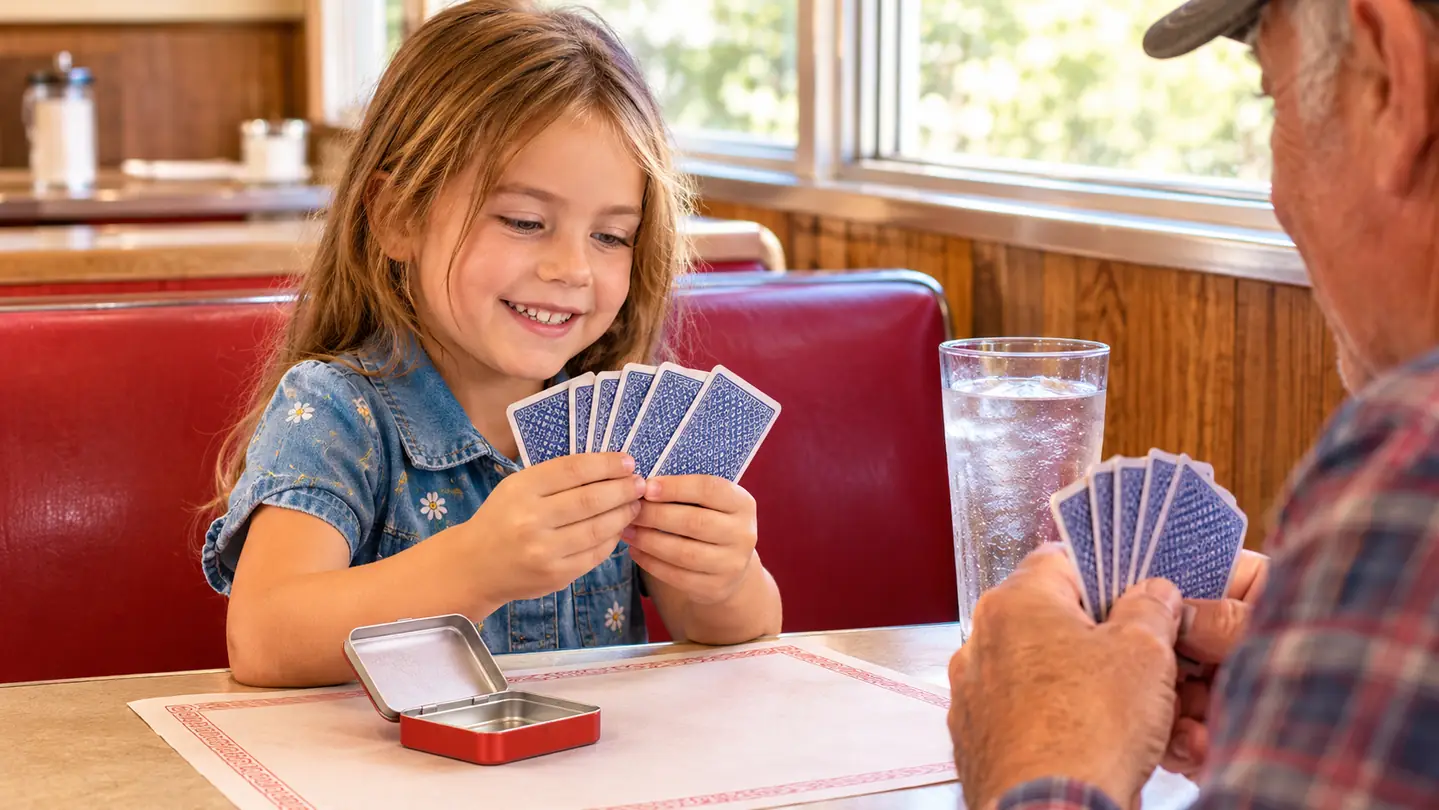
If you want one plain way to choose between these two, borrow the test I use. Picture the appointment that runs forty minutes late with a 5-year-old in a hard chair. A board game does not survive that room. There is nowhere to spread out, no room for the pieces, and the floor is not an option. The tin survives it. I have played Go Fish in a cardiologist's waiting room with a child on either side of me and nobody complained, including the lady across from us who eventually started helping Eli count.
The same goes for a restaurant. A card game occupies the space of two placemats and keeps small hands busy while the food is ordered. A board game needs the whole table, and on a Saturday night the whole table is not available. If your visits with your grandkids mostly happen in public, in cars, or in the sliver of time between school pickup and dinner, the tin is the one you will actually use. If your visits happen at home with an hour to fill, the board game earns its place.
The Things I Would Change
Nothing is perfect. Slap Jack gets physical, and Eli is 4 and does not always remember that slapping the table is the game and slapping his sister is not. The cards are plastic and hold up far better than paper, but after a year and a half of Saturdays the edges of the Go Fish deck have gone soft and one card has a crease in it. The rules card is small print, so I read it once and then explained it out loud, which is fine for me and less fine for a grandfather who cannot find his glasses.
One more thing worth saying plainly. The listing notes that games may vary, so the six decks in your tin can differ from the six in mine. If your grandchild has decided that Old Maid is the entire point of visiting, check the set before you wrap it. I would rather tell you that now than have you find out on Christmas morning with a child looking at you.
Who Should Buy Which
Buy the Regal Games card tin if your grandkids visit in short bursts, if you see them in restaurants and waiting rooms, if you mail gifts and want something that fits in a padded envelope, or if you have more than two children at the table and need a game that seats six. Buy it if you want something to do together that needs no screen, no battery and no subscription, and if the children in question are four or older.
Buy the board game if your grandchild is under four and cannot read yet, if the gift is the main event of the visit and you want the box to do some of the work, or if the child is old enough for a game that runs past half an hour. There is no rule that says you cannot do both. My closet has board games in it. It is just that the tin is the one that comes with me, and if you asked Mia which one she would rather see come out of my purse on a Saturday, she would not need a minute to think about it.
Small tin, six games, one very good Saturday
It has ridden in my purse for a year and a half and has never once needed batteries, a screen or a subscription. If you are buying for a grandchild who is four or older, start here.
Amazon Check Today's Price on Amazon →