
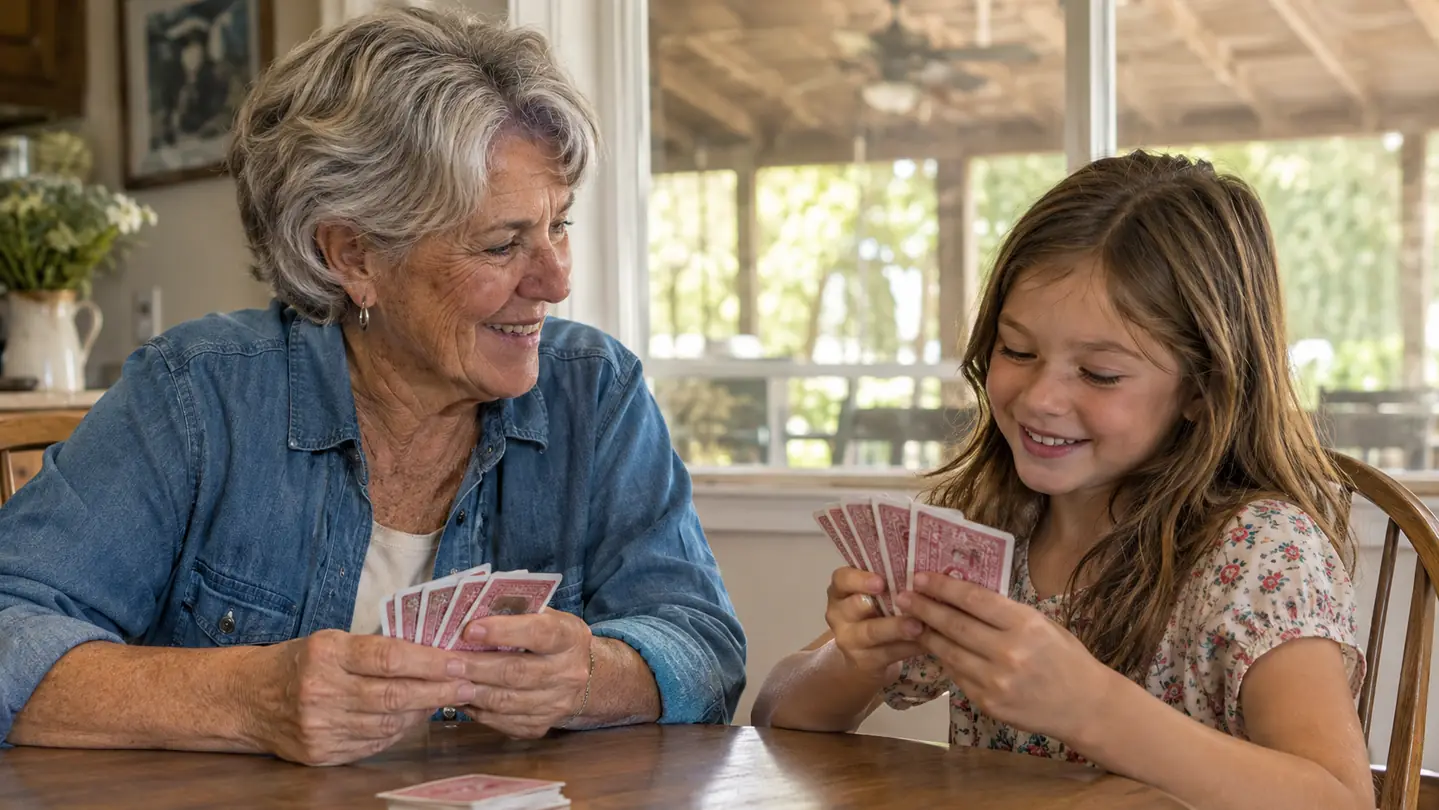
The hard part of a grandchild's visit is not the visit. It is the hour after lunch, when the plates are cleared, the backyard is too hot for anybody, and a small person has already asked to watch something. I have a shelf of toys in the spare bedroom for exactly this moment, and most of them get dumped on the floor, half played with, and abandoned by the time I come back with the lemonade. What actually keeps Mia and Eli at the kitchen table is a deck of cards.
About a year and a half ago I dropped the Regal Games Card Games for Kids tin in my purse before Saturday lunch, and it has not left since. It is a small tin, four inches by two and a half, and inside are six decks: Go Fish, Crazy 8s, Old Maid, Slap Jack, Garbage Monster, and War. No board. No pieces to lose under the stove. Nothing that beeps or needs charging. And because it lives in my purse instead of on the toy shelf, it comes out at restaurants, in the doctor's waiting room, and on the three-hour drive up to Oklahoma City to see Sophie.
Six decks, one small tin, and no pieces to lose under the stove
The Regal Games set covers Go Fish, Crazy 8s, Old Maid, Slap Jack, Garbage Monster, and War in a tin that fits in a purse. Built for two to six players, recommended for ages four and up, so it works whether one grandchild is at the table or four adults and three children are.
Amazon Check Today's Price on Amazon →Step 1: Teach Go Fish First, and Play Nothing Else That Day
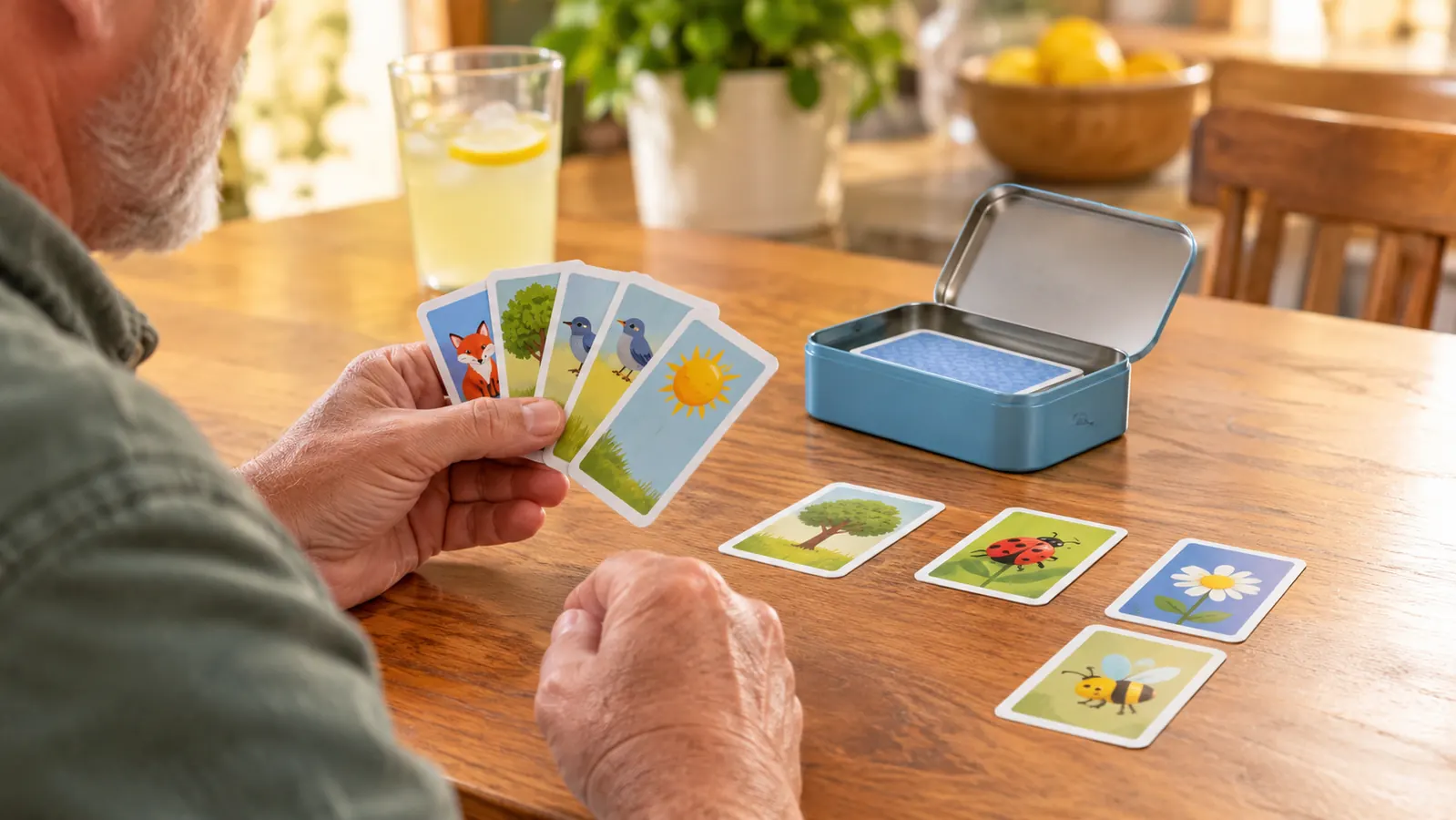
The mistake I made the first Saturday was opening the tin and explaining all six games at once. Eli lasted about ninety seconds before he was under the table. Go Fish is the right first game because it has one rule and one question: do you have any fours. A child who can match two pictures can play it. A child who cannot read yet can play it, because the number sits in the corner and the picture sits in the middle, and the symbols on these cards are plain enough to read from across a table.
We dealt five cards each the first time, which was too many for a four-year-old with small hands. Eli could not hold a fan of cards and ask a question at the same time, so we cut him down to three cards and laid the rest face up on the table in front of him. Mia, who was past her fifth birthday that summer, took to five cards without any trouble at all. Within a month Eli was beating me six hands straight, mostly because he kept asking for the same number over and over until it finally worked.
The other reason to start with Go Fish is that losing does not sting. There is no score kept and no winner until the cards run out, and a bad hand just means more turns. When Eli lost his first few games he genuinely did not notice, and by the time he was old enough to notice, he had won enough that it stopped mattering. Pick one game per visit for the first month. The Regal tin is not going anywhere.
Step 2: Play the First Few Rounds With Your Hand Face Up
This is the single thing that made the biggest difference with Mia. For the first three or four rounds I turned my cards toward her and talked through what I was doing out loud. I have two sevens, so I am going to ask you for a seven, because if you have one I get another turn. She is a child who wants to understand the why of a thing, and once she heard the reasoning out loud she started asking for cards she was already holding, which is the actual skill inside the game.
It also lets you watch the exact moment a child stops guessing and starts paying attention. With Eli that moment came when he noticed I had asked him for the same number twice in a row. He looked at his own cards, looked up at me, and said, you already got those. He was four. I nearly fell out of my chair.
Do not do this forever. After a few rounds, turn your cards back around and play it straight. The point is to make the game make sense to them, not to play it for them. With Mia it took two Saturdays. With Eli it took closer to two months, and I would turn my cards around for ten minutes at the start of every visit and then put them back.
Step 3: Bring In Old Maid Second, and Make the Old Maid Funny
Old Maid is the one Mia asks for by name every single Saturday, and it is the one that teaches the most, because the whole game is about watching a face. Everybody gets a hand, pairs go down, and you draw from the player on your left until only one card is left. Whoever is holding the Old Maid at the end loses. That is the entire game, and a seven-year-old can hold it in her head without help.
Some children get genuinely upset about being stuck with the Old Maid, and a few get a little spooked by her. My fix was to make her ridiculous instead of scary. We gave her a voice. We gave her a little song, which is the sort of thing that happens at my table, since I sang in the church choir for thirty years and there is usually an Elvis record on in this house. By the second Saturday, being left with the Old Maid was the funniest thing that could happen to you, because then you had to stand up and sing. That deck in the Regal Games set has been shuffled more times than any other one in the tin, and it shows.
One practical note. At four, Eli could not hold a fan of cards and pull one out at the same time without showing me his whole hand. So he laid his cards face down in a row on the table and Mia drew from the row instead. That worked fine, it kept him from getting frustrated, and it saved an argument between the two of them about whether he was cheating.
Step 4: Let Them Shuffle, Deal, and Get It Wrong
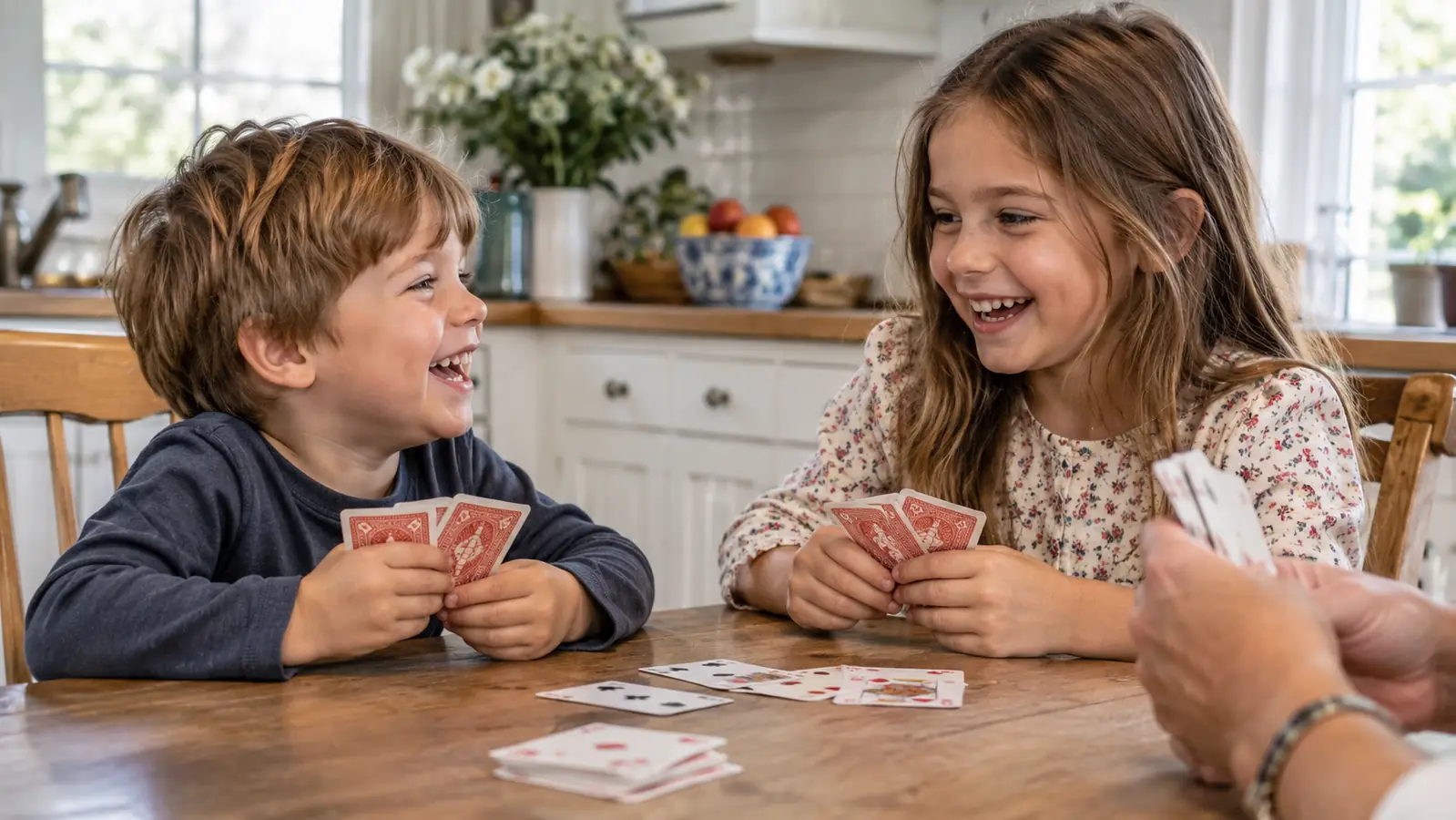
I had to let go of a few things. The cards in the Regal Games set are plastic rather than paper, which is the only reason this tin has survived a year and a half of what Eli calls shuffling, which is really a pile he pushes around the table with both hands. The tin is small and the lid stays on, so there is nothing to spill in the car and nothing to lose in a restaurant booth.
Slap Jack is Eli's favorite, and it is the one that needs a house rule before the first card is turned. Two children and a stack of cards means hands going everywhere at once. My rule is simple: hands flat on the table, and you never touch the other player's hand. If you slap a hand instead of the pile, you give a card back. That one rule has kept the game from ending in tears about eight times out of ten, and the tenth time is why I keep a box of tissues on the same shelf.
Let them deal, even when the piles come out uneven. Let them be the dealer and hand out cards one at a time and lose count somewhere in the middle. The dealing is half the fun at that age. The game can wait, and the game will still be there when they finish.
Step 5: Keep the Tin by the Door and Play in the Small Gaps
The mistake I see other grandparents make is saving games for a big planned occasion. The best card games happen in ten-minute gaps. While the pasta water comes to a boil. While we wait for a table at the restaurant on Cooper Street. In the doctor's waiting room, which is where that little Regal tin has earned its keep more than anywhere else I can name.
Because it fits in my purse, it goes everywhere I go, and the drive up to Oklahoma City is three hours. There is not much for a child to do in the back seat of a car for three hours, so we play War across the seats, which needs no table and no reading and no explaining after the first round. Eli still needs help holding his stack, but he can count to ten now, and counting to ten is the whole game.
The other thing that tin does is include everybody. The set is built for two to six players, so when Rachel and Daniel are both home with their families at the same time, four adults and three children can all sit down at one table. That has happened exactly twice since I bought it, and both times it was the best hour of the whole visit.
What Else Helps
Know where the youngest one actually fits. The listing recommends ages four and up, and that lines up with what I have watched at my own table. Mia was ready at five. Eli was ready at four, barely, and only because he is a child who wants to be in the middle of whatever his sister is doing. Sophie is two and lives in Oklahoma City, and she is nowhere near ready for the rules. When she visits, she gets a hand of three cards and hands them to me one at a time, which she believes is the game. It is close enough.
Send a tin ahead if you are a long-distance grandparent. I mailed a wooden stacker up to Sophie when she was small, and I will mail her a Regal Games tin of her own when she turns four. It weighs eight ounces, it does not need batteries, it does not need an app or a subscription, and it gives the two of you something to do together over a video call instead of just waving at a screen.
Pair the cards with whatever the child already loves. Mia's card games turn into shows, because everything in her life turns into a show, and Old Maid now ends with a performance. If your grandchild is a builder, hand the winner a sticker. If your grandchild is a talker, let them narrate every single hand. The cards are the excuse to sit down together. They are not the point.
And put a snack-free rule on the table. These cards have been through a lot in eighteen months, including a restaurant floor and one unfortunate incident with a juice box, but jam is where I draw the line. Wipe the table, deal the cards, and save the cookies for after.
Eli was four and could not hold five cards and ask a question at the same time, so he played three-card Go Fish for a month. Then he beat me six hands straight.
The game is the excuse. The hour at the table is the point.
Six classic decks in one small tin: Go Fish, Crazy 8s, Old Maid, Slap Jack, Garbage Monster, and War. Two to six players, ages four and up, eight ounces, and small enough to live in a purse for the waiting rooms and restaurant booths and long drives.
Amazon Check Today's Price on Amazon →